
Learn the five major Makharij areas and the 17 articulation points used for correct Quran pronunciation and Tajweed.
Have you ever read a Quranic word correctly from the page, yet felt that it did not sound the same when a skilled reciter pronounced it?
The problem may not be your ability to recognize Arabic letters. Often, it is where the sound is coming from.
Arabic contains sounds that do not have a direct equivalent in English, Urdu, and many other languages. Letters such as ع, ح, خ, غ, ق, ص, ض, ط, and ظ can therefore feel unfamiliar at first. A learner may know exactly which letter is written but still pronounce it using the closest sound from their own language.
Makharij Al-Huruf teaches us to correct that at the source. Instead of only asking, “What does this letter sound like?”, we learn to ask, “Where should this sound come from?”
Once that idea becomes clear, Quran pronunciation starts to make much more sense.
This guide explains the five major articulation areas, the commonly taught 17 specific articulation points, frequent pronunciation mistakes, and practical ways to train your mouth, tongue, throat, and lips for clearer Quran recitation.
What Is Makharij Al-Huruf?
Makharij Al-Huruf (مخارج الحروف) means the articulation points of the Arabic letters—the places from which their sounds emerge.
Makhraj is the singular form. It refers to the point of exit or place of articulation of a letter. Makharij is its plural, while Huruf means letters.
This becomes easier to understand when you try two letters that look different but can sound similar to a beginner.
Say:
كَ — Ka
Now say:
قَ — Qa
The vowel is the same, but the consonant should not come from the same place. ق (Qaf) is produced farther back than ك (Kaf).
If both letters come out like an ordinary “k,” knowing their names has not solved the pronunciation problem. The tongue has to learn the difference too.
That physical understanding is one of the foundations of Tajweed.
Why Does Correct Quran Pronunciation Matter?
Every Arabic letter has its own identity. Part of preserving that identity is giving the letter its correct articulation.
This matters because Arabic includes several sounds that are very close to one another:
س and ص
ت and ط
د and ض
ك and ق
ه and ح
ذ and ظ
To an inexperienced ear, the difference may seem small. In Arabic, however, they are different letters.
If one letter is replaced by another, the word itself may sometimes change. That does not mean a beginner should become frightened of every pronunciation error. Learning Quran recitation is a gradual process, and correction is part of that process.
The useful approach is to hear the difference, understand what your mouth should be doing, and improve it through repetition.
Good Makharij also makes later Tajweed study easier. Rules of Noon Sakinah, Meem Sakinah, Madd, Qalqalah, Ghunnah, and other areas are much easier to apply when the letters themselves are already being formed clearly.
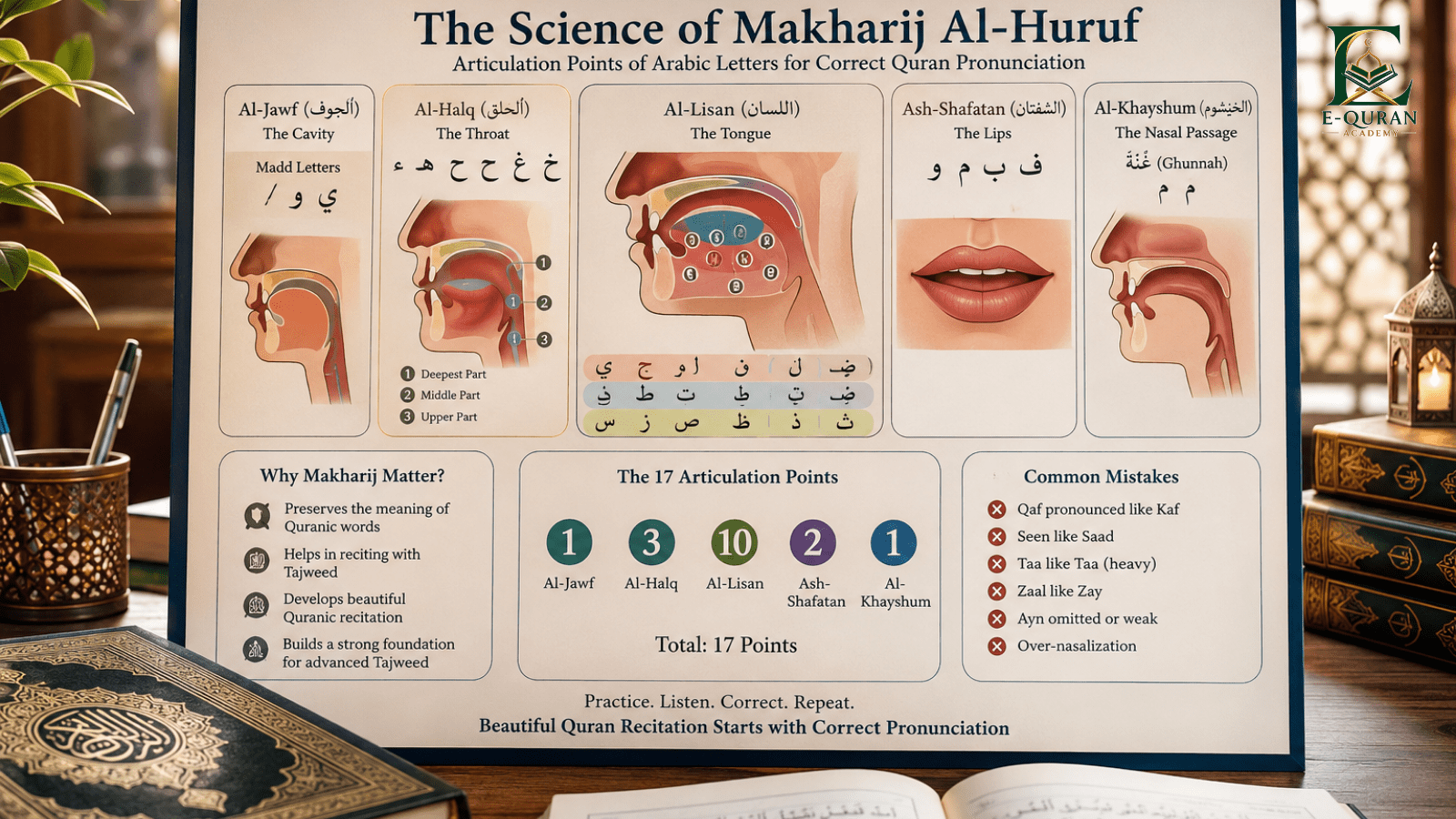
The Five Major Makharij Al-Huruf Areas

The commonly taught Tajweed framework places the detailed articulation points within five broad areas:
- Al-Jawf (الجوف) — the open cavity of the mouth and throat
- Al-Halq (الحلق) — the throat
- Al-Lisan (اللسان) — the tongue
- Ash-Shafatan (الشفتان) — the two lips
- Al-Khayshum (الخيشوم) — the nasal passage
It is easier to learn these five areas first rather than trying to memorize every detailed point at once.
1. Al-Jawf — The Open Cavity
Al-Jawf is the open space inside the mouth and throat.
Unlike many consonants, the sounds associated with Al-Jawf do not depend on the tongue firmly touching a particular place.
This area is connected with the three Madd letters:
- ا when it is a Madd Alif preceded by Fathah
- و when it is a Madd Waw preceded by Dammah
- ي when it is a Madd Ya preceded by Kasrah
You hear them as extended vowel sounds similar to:
aa — oo — ee
Try saying a long “aa” slowly. Notice that your tongue is not striking a fixed point to produce the sound. The voice flows through the open cavity.
This is different from a letter such as ب, where the lips clearly meet.
2. Al-Halq — The Throat
The throat contains three specific articulation points and six letters.
From the deepest part of the throat come:
ء — ه
From the middle of the throat come:
ع — ح
From the part of the throat closer to the mouth come:
غ — خ
These six letters deserve extra attention because learners often replace them with sounds they already know.
Take ح. It should not simply become the normal “h” sound used in English. The sound is formed deeper, from the middle area of the throat.
ع (‘Ayn) can be even more challenging. Some learners leave it almost silent because their native language has no equivalent. Others replace it with a vowel.
Neither approach teaches the tongue and throat what the Arabic letter actually requires.
Do not force these sounds harshly. Correct articulation comes from learning the proper position and practicing it carefully.
3. Al-Lisan — The Tongue
Most Arabic letters involve the tongue, so this is the area where beginners usually spend the most time.
The tongue does not have one single Makharij position. Its back, middle, sides, and tip all contribute to different letters.
At the back of the tongue, we find:
ق — Qaf
ك — Kaf
The middle portion is involved in:
ج — Jeem
ش — Sheen
ي — Ya when it is not a Madd letter
The side of the tongue has an important role in producing:
ض — Dad
Other tongue positions are used for:
ل — Lam
ن — Noon
ر — Ra
The tongue tip and the area near the teeth help produce groups such as:
ط، د، ت
ص، ز، س
and:
ظ، ذ، ث
You do not need to memorize all of those positions in one sitting.
Pick a difficult pair and feel the difference.
Try:
سَ — صَ
Then:
تَ — طَ
Say each pair slowly. Do not chase speed. Ask yourself what changed in your tongue and the shape of your mouth.
That awareness is far more useful than repeating a letter fifty times without knowing what you are trying to correct.
4. Ash-Shafatan — The Two Lips
A few Arabic letters depend directly on the lips.
These include:
ف — Fa
ب — Ba
م — Meem
و — Waw when used as a consonant
For ف, the inner part of the lower lip comes into contact with the edges of the upper front teeth.
For ب, the two lips close together and then release.
م also uses both lips, but its sound has a different quality and can carry nasal resonance where the rules of Tajweed require Ghunnah.
With consonantal و, the lips are rounded.
A mirror can actually help here. Watching your own lip movement makes some pronunciation errors much easier to spot.
5. Al-Khayshum — The Nasal Passage
Al-Khayshum refers to the nasal passage and is associated with Ghunnah, the nasal resonance heard with Noon and Meem in relevant Tajweed situations.
Try holding the sound:
mmmm
or:
nnnn
You should notice resonance around the nose.
That does not mean every Noon or Meem should be exaggerated through the nose. The strength and duration of Ghunnah depend on the Tajweed rule being applied.
For beginners, the first goal is simply to understand that this sound has a nasal component and does not come only from the lips or tongue.
Makharij Al-Huruf and the 17 Specific Articulation Points
You may hear one teacher mention five Makharij while another lesson talks about 17 articulation points. These statements are not necessarily contradictory.
The five are the general articulation areas.
Within those areas, the commonly taught system identifies 17 more specific points:
- Al-Jawf: 1
- Al-Halq: 3
- Al-Lisan: 10
- Ash-Shafatan: 2
- Al-Khayshum: 1
Total: 17 specific articulation points
For a new student, there is no benefit in turning this into a memory test.
First learn the map.
The throat has its letters. The tongue has several regions. The lips produce certain letters. The nasal passage carries Ghunnah. The open cavity carries the Madd sounds.
Once that map feels familiar, the 17 detailed points become much easier to study.
How Do You Find the Makhraj of a Letter?
There is a practical method often used when studying Makharij: isolate the consonant sound rather than hiding it inside a flowing word.
For example, instead of repeatedly saying قَ, pay attention to the point where the ق itself begins.
Where does your tongue move?
What touches what?
Where does the airflow pass?
Try the same process with ب. You can immediately feel the lips close.
With ف, you should notice the relationship between the lower lip and upper teeth.
With ث, notice what happens at the tip of the tongue near the upper front teeth.
Makharij becomes much easier when you stop treating pronunciation as something that only the ears do. Your mouth gives you physical feedback as well.
Common Makharij Mistakes Beginners Make
A student may repeat the same pronunciation for years simply because no one has pointed out what needs changing.
Some common problems include:
- Turning ق into a sound too close to ك
- Reading ث as “s” or “t”
- Pronouncing ذ like “z”
- Making ص sound identical to س
- Making ط too similar to ت
- Replacing ح with an ordinary “h”
- Weakening ع until it is barely heard
- Pronouncing ض like a simple “d”
- Overdoing heavy letters until they sound forced
- Adding nasalization where Ghunnah is not required
Native language habits have a strong influence here.
An Urdu speaker may find one group of sounds easier, while an English speaker may struggle with another. An Arabic speaker can also have pronunciation habits that need correction when studying Tajweed formally.
The solution is not simply “try harder.” You need to know which part of the pronunciation is wrong.
How to Improve Your Quran Pronunciation
Work on one problem at a time
If ق and ك are difficult, spend a few days on that pair instead of trying to fix ten letters together.
Practice:
قَ قِ قُ
then:
كَ كِ كُ
After that, use the letters in short Quranic words under a teacher’s guidance.
Listen with a purpose
Listening to good Quran recitation is valuable, but passive listening is different from pronunciation practice.
Choose one short passage. Pick one letter. Listen specifically for that sound.
Where does it feel stronger? How does it differ from the sound you normally make?
Then repeat.
Record your own voice
Your voice sounds different when you hear it played back.
Record only two or three lines. Listen for the letter you are currently training rather than judging your entire recitation.
That makes self-review manageable.
Use a mirror
This works particularly well with letters involving the lips or front of the tongue.
For ف، ب، م، و، ث، ذ، and ظ, visual feedback can help you understand what your mouth is doing.
Slow down
Many pronunciation problems disappear during isolated practice and return as soon as the student starts reciting quickly.
If that happens, the sound has not yet become automatic.
Slow down again.
Accuracy first. Speed develops naturally with familiarity.
A Simple 15-Minute Makharij Practice Routine
You do not need an hour every day to improve.
Try this:
3 minutes:
Warm up with the letters you currently find difficult.
4 minutes:
Practice one similar-sounding pair, such as س / ص or ك / ق.
4 minutes:
Read a few words containing those letters.
2 minutes:
Listen to accurate recitation of the same words or verses.
2 minutes:
Record yourself and listen back once.
The next day, continue with the same pair if it still feels unstable.
There is no prize for moving to the next letter quickly.
Why Learning Makharij With a Tajweed Teacher Helps
There is one difficulty with pronunciation that books cannot completely solve: you may not hear your own mistake.
If you have always pronounced ع a certain way, that version may sound normal to you.
A qualified Tajweed teacher can hear the difference immediately and tell you what needs adjustment. Sometimes the correction is surprisingly small: move the tongue slightly back, reduce unnecessary pressure, open the mouth differently, or stop replacing an unfamiliar sound with a familiar one.
A teacher can also prevent overcorrection.
When students learn that a letter is “heavy” or comes from the throat, they sometimes push the sound too hard. Direct feedback helps keep pronunciation accurate without making recitation unnatural.
Online Quran classes can be especially useful for this type of practice because the student can recite, receive correction, repeat the letter, and try again while the mistake is still fresh.
Final Thoughts on Mastering Makharij Al-Huruf
You do not master Quran pronunciation by memorizing the names of 17 articulation points.
You master it by slowly training your ear and speech organs to recognize the difference between one Arabic letter and another.
That is the real value of Makharij Al-Huruf.
Begin with the five major areas. Learn where your difficult letters come from. Compare similar sounds. Practice them separately before placing them back into words and verses.
Most importantly, allow yourself to be corrected.
A letter that feels difficult today can become natural after enough careful repetition.
If you would like to improve your Quran pronunciation with individual correction, learning Tajweed with a qualified Quran teacher can help you identify your mistakes and work through them step by step.