Complete Beginner’s Guide | No Arabic Background Needed | ~6 min read
If you have ever listened to a Quran recitation and felt something move inside your chest, something you could not quite explain, there is a good chance that what you heard was the Quran being recited with Tajweed. The precision of every letter, the gentle rise and fall of every phrase, the way certain sounds carry more weight than others. It all comes from a carefully preserved set of rules that have been passed down for over fourteen centuries.
But what exactly is Tajweed? Is it something only advanced scholars need? Is it difficult to learn? And if you are a complete beginner with no Arabic background, where would you even start?
This guide answers all of those questions clearly and honestly. By the end, you will understand what Tajweed in Quran recitation means, why it matters, and how you can begin learning it today.
What Does the Word Tajweed Actually Mean?
The word Tajweed comes from the Arabic root word “jawwada,” which means to improve, to do well, or to make something better. In the context of Quran recitation, it refers to the set of phonetic and pronunciation rules that govern how each letter and word of the Quran should be correctly produced.
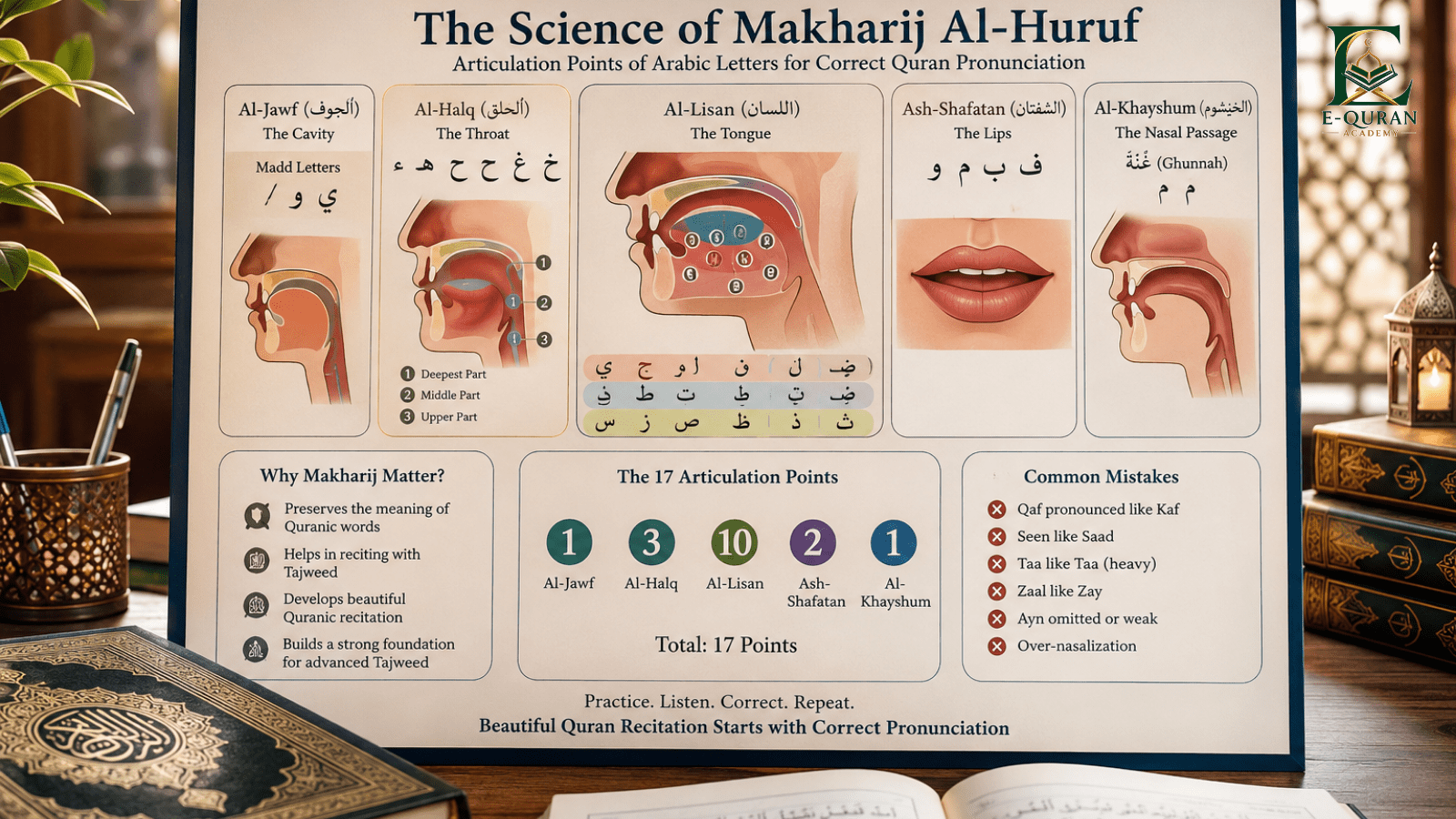
Think of it this way. Every letter in the Arabic language has a specific place in the mouth or throat where it is formed. Some letters come from deep in the throat. Some come from the tip of the tongue. Some require your lips to close. Some require a specific nasal sound. Tajweed is the science that tells you exactly where each sound comes from and how it should be shaped when you are reading the words of Allah.
This is not just an academic exercise. The Quran was revealed to the Prophet Muhammad, peace be upon him, with a specific sound and a specific delivery. He taught it to his companions, who taught it to the next generation, and so on, all the way to today. Tajweed is what has kept the Quran sounding exactly as it was originally revealed, without a single letter being distorted or lost.
| KEY FACT. The Arabic word Tajweed literally means to do something with excellence. When applied to the Quran, it means reading every single letter with the excellence it deserves. That is the simplest way to understand what Tajweed is. |
Why Is Tajweed Important in Quran Recitation?
One of the most common questions beginners ask is this: does it really matter how I pronounce the letters, as long as I am trying my best? The answer requires a little explanation.
Arabic is a language where the difference between one letter and another is not just a matter of accent or dialect. It can change the meaning of a word entirely. For example, the letter “qaf” and the letter “kaf” are both present in the Arabic alphabet and sound somewhat similar to an untrained ear. But they are produced in completely different parts of the throat and mouth. Confusing them in certain words of the Quran can alter the meaning of what is being said.
This is why Islamic scholars agree that reading the Quran with correct Tajweed is an obligation. It is not a luxury for the advanced student or an optional extra for those who enjoy beautiful recitation. It is the standard that every Muslim should work towards, even if reaching full mastery takes time.
The Prophet, peace be upon him, also said that a person who recites the Quran with difficulty while genuinely trying to do so correctly will receive double the reward. So even the beginner who is still learning and making mistakes is in a position of reward, not failure, as long as the effort is sincere.
The Rules of Tajweed: A Beginner Overview
Tajweed is made up of several interconnected rules. Each rule covers a specific situation that occurs repeatedly throughout the Quran. You do not need to memorise all of them before you begin reading. But knowing what they are helps you understand what your teacher is teaching you and why.
8 Core Tajweed Rules Every Beginner Should Know
| Rule 01 Makhraj al-Huruf The exact articulation point of each letter — where in the mouth or throat it is produced. | Rule 02 Sifat al-Huruf The characteristics of each letter: heavy or light, echoing or smooth, nasal or clear. |
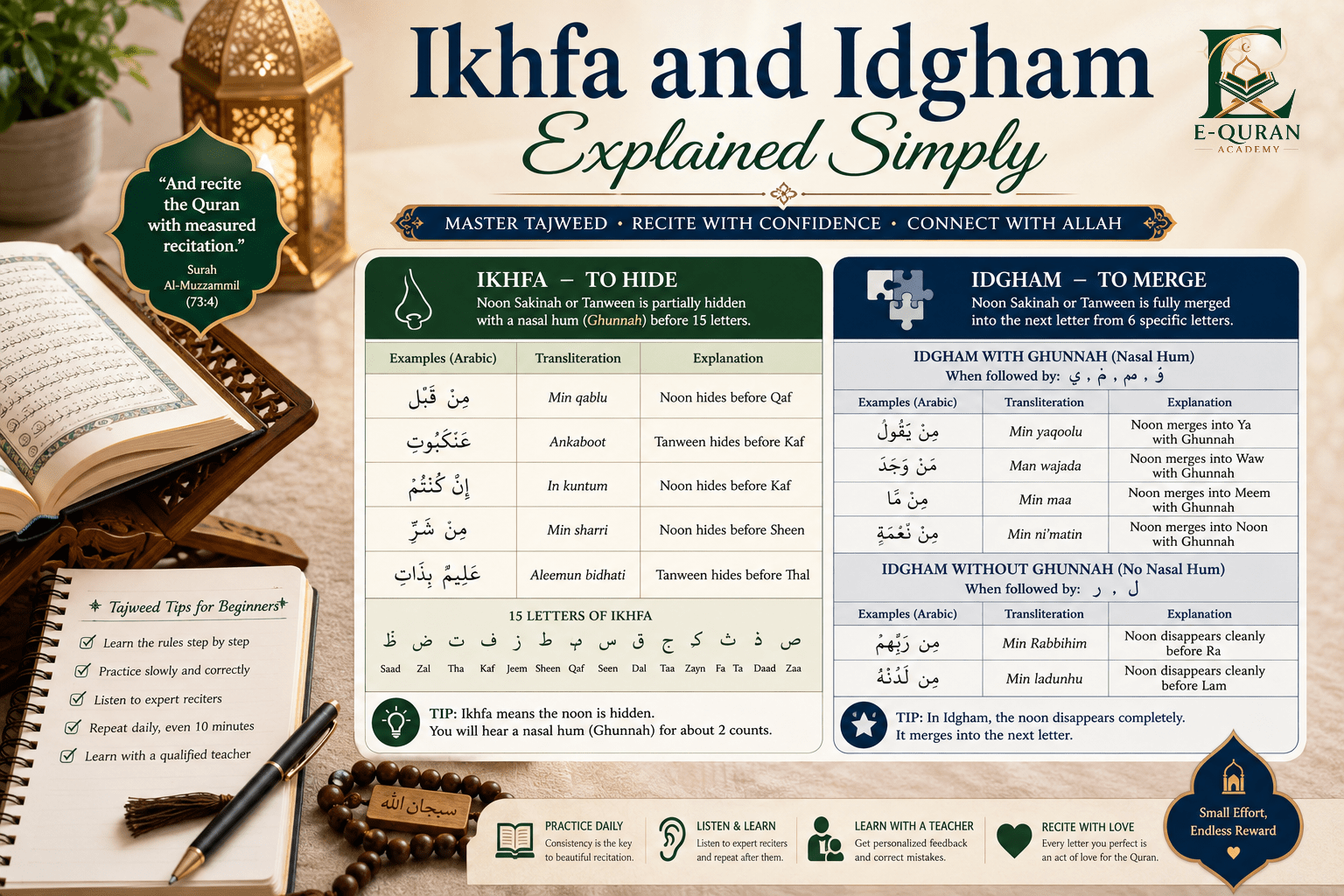
| Rule 03 Noon Saakin and Tanween Four rules governing how the noon sound changes depending on the letter that follows it. | Rule 04 Meem Saakin How a silent meem interacts with the next letter, including Ikhfa Shafawi and Idgham Shafawi. |
| Rule 05 Madd (Elongation) How long certain vowel sounds are stretched. Different types require different beat counts. | Rule 06 Qalqalah A slight bouncing echo applied to five specific letters when they appear with a sukoon. |
| Rule 07 Ghunna (Nasalisation) A nasal sound held for two counts, applied to noon and meem in certain positions in the Quran. | Rule 08 Waqf (Stopping Rules) Rules for where to pause, where to continue, and where you have a choice during recitation. |
Each of these rules sounds more complicated in description than it actually feels in practice. When a good teacher introduces them one at a time, with examples from the Quran you already know, they begin to make natural sense quite quickly.
Tajweed with a Teacher Versus Learning Alone
This is one of the most important points in this entire guide, so it deserves its own section.
Tajweed is an oral tradition. It was never meant to be learned purely from a book or a video. The reason is straightforward. The rules of Tajweed involve sounds that simply do not exist in most other languages. The deep throat letters, the heavy letters, the nasal elongations. You can read about how to produce these sounds for weeks and still get them wrong because your ear has never heard them and your mouth has never attempted them.
A qualified teacher can hear exactly where your mouth is going wrong and correct it in real time. That is the whole point of the student and teacher relationship in Tajweed. It is why Islamic scholars say that recitation must be learned with the mouth of a teacher, not only with the eyes of a reader.
The good news is that finding a qualified teacher is now easier than it has ever been. Online Tajweed classes for beginners have made it possible to learn from a certified teacher without leaving your home, without adjusting to a fixed timetable, and without any prerequisite knowledge of Arabic. Platforms like E Quran Academy offer one on one sessions where the entire lesson is built around your level, your pace, and the specific sounds you are still working on.
Reading Without Tajweed Versus Reading With Tajweed.
Many beginners ask what the actual difference looks and sounds like between reading with Tajweed and reading without it. This comparison makes it clear.
Side by Side Comparison: Without Tajweed vs With Tajweed
| Reading Without Tajweed | Reading With Tajweed |
|---|---|
| Letters may be mispronounced, sometimes changing word meanings entirely | Every letter is produced from its correct articulation point with precision |
| Elongations are guessed at or skipped, making recitation uneven | Each elongation is held for the exact required number of counts |
| Heavy and light letters sound identical to the listener | Heavy and light letters are clearly distinct in sound and weight |
| Stopping places in verses are chosen randomly or by breath alone | Pauses follow specific Waqf rules that preserve the meaning of each verse |
| Recitation can sound flat, rushed, or inconsistent in its rhythm | Recitation has natural, flowing musicality rooted in careful precision |
How to Start Learning Tajweed as a Complete Beginner.
If you have never studied Arabic and the idea of learning Tajweed feels overwhelming, here is the honest truth. Every qualified reciter you have ever heard started exactly where you are now. They started with the alphabet. They started by not knowing the difference between the letters. And with consistent effort and a good teacher, they built their skill one lesson at a time.
5 Steps to Begin Your Tajweed Learning Journey
| # | Step | What to Do and Why |
|---|---|---|
| 1 | Learn the Arabic Alphabet First | You need to recognise and produce the 28 Arabic letters before any Tajweed rule can be applied. This is the non-negotiable first step. |
| 2 | Work Through Noorani Qaida | This is the globally used beginner textbook that moves from individual letters to joined letters to short words in a structured, proven sequence. |
| 3 | Work with a Certified Teacher from Day One | Do not wait until you feel ready. Starting with a teacher from the beginning means you avoid forming wrong habits that become hard to unlearn later. |
| 4 | Practise Out Loud Every Single Day | Even ten to fifteen minutes of focused daily reading out loud will compound into real progress over weeks and months. Silence does not build the skill. |
| 5 | Listen to Skilled Reciters Alongside Your Lessons | Sheikh Sudais, Sheikh Minshawi, and Sheikh Al-Husary are widely recommended. Daily listening trains your ear to recognise correct Tajweed naturally. |
| BEGINNER ENCOURAGEMENT. The Prophet (PBUH) said that the person who recites the Quran fluently will be with the noble and obedient angels. And the one who recites with difficulty, striving hard, will receive a double reward. You are rewarded for trying, not just for being perfect. Start today. |
Is Tajweed Only for Recitation or for Daily Prayer Too?
This is a question many beginners do not think to ask, but it is worth addressing clearly. The answer is that Tajweed applies to every recitation of the Quran, including the surahs you recite in your daily prayers.
Every Muslim who prays reads Surah Al-Fatiha at least seventeen times a day. They recite additional surahs in most units of prayer. Applying the rules of Tajweed to these surahs, even imperfectly as a learner, transforms every single prayer into a more attentive and connected act of worship.
This is one of the most beautiful things about learning Tajweed. The benefit does not wait for you to finish a course or reach a certain level. It begins from your very first correct letter, in your very next prayer.
Free Resources Versus Structured Classes.
There are free resources available online and they have real value. YouTube videos can give you an introduction to how certain letters sound. Apps can help you follow along with the text. Audio recordings let you hear correct recitation repeatedly.
But none of these replace a qualified teacher for the reasons already explained. Free resources are best used as supplements to your structured lessons, not as substitutes for them. Use them to reinforce what your teacher has already shown you. Use them to expose your ear to correct recitation. But for actual skill development and error correction, a real teacher is irreplaceable.
Why Tajweed Is a Gift Worth Pursuing.
Learning Tajweed is one of the most rewarding journeys a Muslim can take. It deepens the experience of prayer. It opens up the beauty of the Quran in ways that reading a translation alone cannot. It connects you to an unbroken chain of reciters stretching back fourteen centuries to the Prophet himself, peace be upon him.
It does not matter how old you are, what language you grew up speaking, or how many times you have tried and stopped before. The rules of Tajweed are learnable. The sounds are producible. The journey is completely available to you.
All it takes is the decision to begin, a qualified teacher to guide you, and the consistency to show up for your lessons and practise what you learn.
That is enough. And it always has been.
| Start Learning Tajweed with a Certified Teacher Today E Quran Academy offers personalised one on one Tajweed classes for beginners of all ages. Flexible timing, qualified teachers, and a free trial class to get you started from home. |