That Moment When Tajweed Feels Confusing.
Picture this. You are sitting with your Quran, reading slowly, trying your best. But then you come across a noon sakinah followed by certain letters and you freeze. Should you pronounce it clearly? Should you hide it? Should the letters blend together?
If this sounds like you, you are in the right place.
So many Muslims kids, adults, and even people who have been reading Quran for years struggle with Tajweed rules like Ikhfa and Idgham. Not because they are not trying. But because nobody explained these rules in a simple, relatable way.
This blog does exactly that. No confusing charts. No hard Arabic grammar. Just clear, friendly explanations that anyone can follow whether you are eight years old or eighty.
Let us start from the beginning.
Why Tajweed Matters in Quran Recitation.
Before jumping into the rules, let us understand why Tajweed even exists.
Allah (SWT) did not just give us the Quran as words on paper. He gave us a way to recite those words beautifully, correctly, and with care. In Surah Al-Muzzammil, Allah says:
“And recite the Quran with measured recitation.” — Surah Al-Muzzammil (73:4)
This verse is a gentle command. Allah is asking us to slow down, pay attention, and recite the Quran the way it was meant to be recited. Tajweed is how we honor that command.
Proper Quran pronunciation is not just about sounding beautiful. It protects the meaning of the words. In Arabic, a small change in sound can completely change a word’s meaning. Tajweed rules like Ikhfa and Idgham were passed down through generations of scholars to preserve the exact recitation of our beloved Prophet Muhammad (PBUH).
When you learn Tajweed, you are not just improving your recitation. You are connecting to a living tradition that stretches back 1,400 years.
What Is Ikhfa in Tajweed?
The word Ikhfa (إخفاء) comes from Arabic and means “to hide” or “to conceal.”
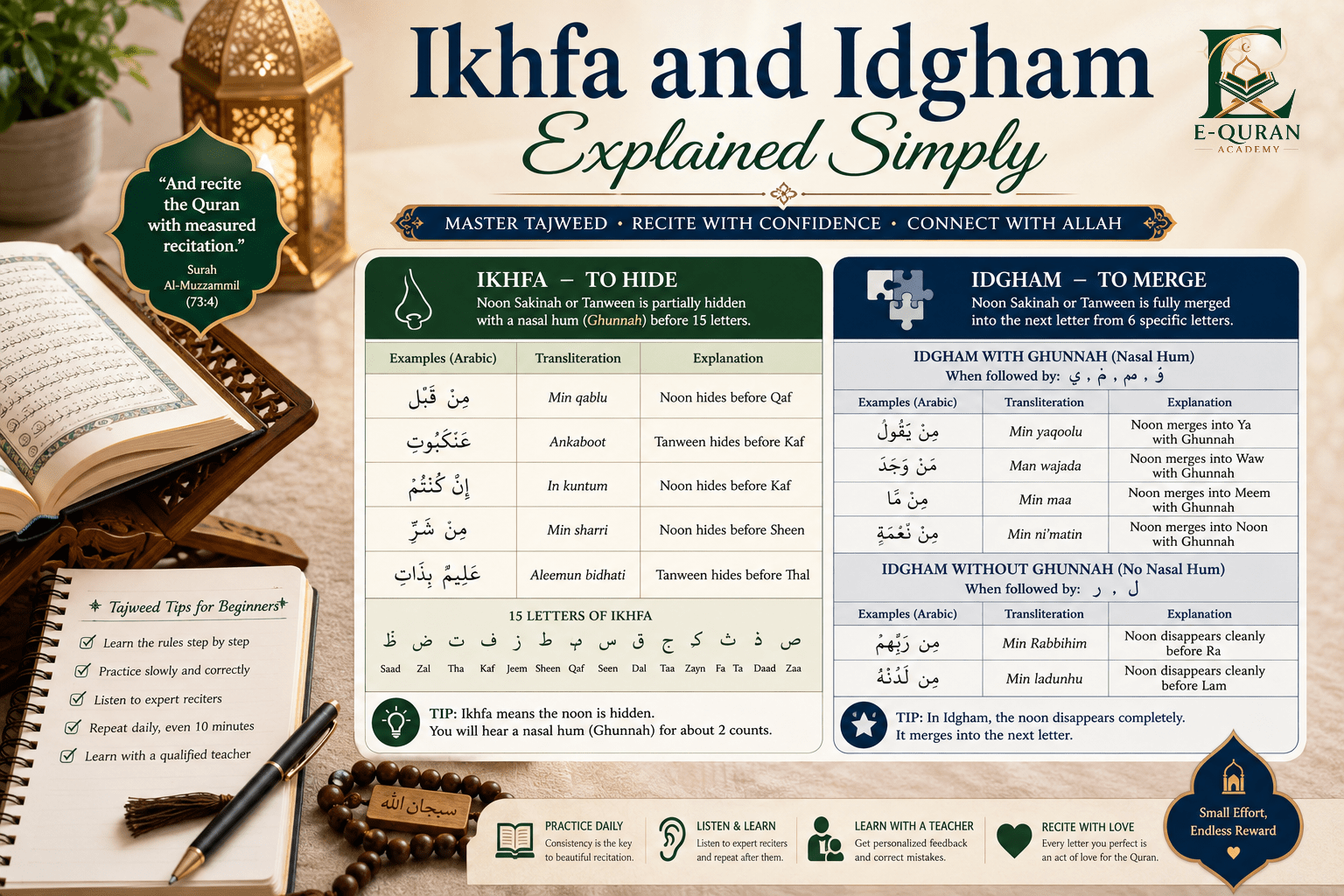
In Tajweed, Ikhfa refers to a situation where the noon sakinah (نْ) or tanween (ـً ـٍ ـٌ) is followed by one of 15 specific Arabic letters. When this happens, you do not pronounce the noon clearly. You do not drop it completely either. Instead, you hold your voice in a middle position somewhere between a clear noon and a full merge.
Think of it like whispering a sound. The noon is still there, but it is hidden beneath a soft nasal hum. This hum is called ghunnah, and it lasts for about two counts.
Simple way to understand it: Imagine holding your nose gently and trying to make a soft “n” sound but not fully saying it. That nasal, half-hidden tone is the feeling of Ikhfa.
Examples in the Quran:
| Arabic | Transliteration | What happens |
| مِن قَبْلُ | Min qablu | Noon hides before the Qaf |
| عَنكَبُوتٍ | Ankaboot | Tanween hides before Kaf |
| إِن كُنتُمْ | In kuntum | Noon hides before Kaf |
In each case, you never drop the noon completely. You keep a soft nasal quality while smoothly moving to the next letter.
Letters of Ikhfa.
There are 15 letters that trigger Ikhfa. A good way to remember them is through this famous Arabic sentence used by Tajweed scholars: صِفْ ذَا ثَنَا كَمْ جَادَ شَخْصٌ قَدْ سَمَا دُمْ طَيِّبًا زِدْ فِي تُقًى ضَعْ ظَالِمًا
Each letter in that phrase represents one Ikhfa letter. They are:
- ص (Saad)
- ذ (Zal)
- ث (Tha)
- ك (Kaf)
- ج (Jeem)
- ش (Sheen)
- ق (Qaf)
- س (Seen)
- د (Dal)
- ط (Taa)
- ز (Zayn)
- ف (Fa)
- ت (Ta)
- ض (Daad)
- ظ (Zaa)
Whenever noon sakinah or tanween appears before any of these 15 letters, apply Ikhfa. Hide the noon partially with a nasal hum.
What Is Idgham in Tajweed?
The word Idgham (إدغام) means “to merge” or “to insert.”
In Tajweed, Idgham happens when a noon sakinah or tanween is followed by one of 6 specific letters. Instead of pronouncing the noon at all, the two letters blend into one. The noon disappears, and the following letter takes over sometimes with a nasal hum, sometimes without.
Simple way to understand it: Imagine two puzzle pieces that click together perfectly. The noon does not just hide it completely merges into the next letter. If you hear someone recite Quran with Idgham, it sounds like the noon was never there.
Idgham only happens when the noon sakinah is at the end of one word and the Idgham letter starts the next word. If both letters are in the same word, Idgham does not apply.
The 6 letters of Idgham are often remembered using the word يَرْمَلُون (Yarmaloon):
- ي (Ya)
- ر (Ra)
- م (Meem)
- ل (Lam)
- و (Waw)
- ن (Noon)
Types of Idgham.
Idgham splits into two types depending on whether it comes with a nasal hum (ghunnah) or without.
Idgham With Ghunnah.
This happens when noon sakinah or tanween is followed by one of these 4 letters: ي، ن، م، و
The noon merges into the next letter, and you hold a nasal hum (ghunnah) for two counts.
Example:
| Arabic | Transliteration | Explanation |
| مِن يَقُولُ | Min yaqoolu | Noon merges into Ya with ghunnah |
| مَن وَجَدَ | Man wajada | Noon merges into Waw with ghunnah |
You will clearly hear the nasal “mmm” sound sustained for a moment before the next letter comes in.
Idgham Without Ghunnah
This happens when noon sakinah or tanween is followed by ر (Ra) or ل (Lam).
Here, the noon fully disappears with no nasal hum at all. The transition is completely clean and immediate.
Example:
| Arabic | Transliteration | Explanation |
| مِن رَبِّهِمْ | Min Rabbihim | Noon disappears cleanly before Ra |
| مِن لَدُنْهُ | Min ladunhu | Noon disappears cleanly before Lam |
If you are practicing this, listen carefully to how a skilled reciter reads these phrases. The noon is simply gone no echo, no hum, nothing.
Difference Between Ikhfa and Idgham
These two rules confuse many beginners because they both involve the noon sakinah changing its sound. Here is a side-by-side comparison to make it crystal clear:
| Feature | Ikhfa | Idgham |
| Meaning | To hide | To merge |
| What happens to noon | Partially hidden with nasal hum | Fully disappears into next letter |
| Number of triggering letters | 15 letters | 6 letters (ي ر م ل و ن) |
| Ghunnah (nasal hum) | Always present | With ي ن م و — yes. With ر ل — no |
| Same word or different? | Can be same word | Must be across two words |
| Sound result | Soft, half-hidden noon with hum | Clean merge — noon vanishes |
A quick trick: if the noon completely disappears and blends with the next letter, that is Idgham. If it partially hides but you still feel a nasal hum, that is Ikhfa.
Common Mistakes Beginners Make.
Everyone makes mistakes when learning Tajweed. The important thing is knowing what to watch out for.
Mistake 1: Pronouncing the noon clearly when Ikhfa is needed. Some readers say the noon too strongly when it should be softened. Practice relaxing the noon and letting the nasal hum take over.
Mistake 2: Mixing up Ikhfa letters with Idgham letters. This is very common. Keep a small reference card of the 15 Ikhfa letters and the 6 Idgham letters nearby until you have memorized them.
Mistake 3: Applying Idgham inside one word. Remember: Idgham only works when the noon is at the end of one word and the triggering letter begins the next word. Words like نَعِمَ (naima) noon and meem are in the same word, so Idgham does NOT apply here.
Mistake 4: Forgetting the ghunnah duration. The nasal hum should last about two counts not one, not three. A common mistake is either rushing through it or holding it too long.
Mistake 5: Not listening to proper reciters. Tajweed is an oral tradition. Reading rules from a book is helpful, but your ears need to hear it correctly too. Listen to reciters like Sheikh Mishary Al-Afasy, Sheikh Mahmoud Khalil Al-Hussary, or Sheikh Abdul Rahman Al-Sudais regularly.
Easy Tips to Improve Tajweed Faster.
Learning Tajweed does not have to feel overwhelming. Here are practical steps that actually work:
Listen before you recite. Pick one short surah and listen to it ten times before practicing. Your tongue will naturally start to copy the correct sounds.
Start with Noorani Qaida. If you are a complete beginner, the Noorani Qaida course is the most trusted starting point. It teaches Arabic letters and basic Tajweed step by step in the right order.
Practice slowly. Speed will come later. Right now, focus on getting each rule right. Slow recitation builds better habits than fast, careless reading.
Learn with a qualified teacher. No book or video can fully replace a real teacher who can correct your mistakes live. At E Quran-Academy, beginners and children can take structured Quran Reading with Tajweed lessons with qualified instructors through convenient online Quran classes from anywhere in the world.
Repeat small sections daily. Even ten minutes a day of focused Tajweed practice builds real progress over weeks and months.
Keep a mistake journal. Every time your teacher corrects you, write it down. Revisiting your common errors regularly helps you fix them faster.
If you want to learn Quran online with proper Tajweed guidance, E Quran-Academy offers beginner-friendly programs for children and adults that make this journey much easier and more enjoyable.
Why Learning Tajweed Step by Step Matters.
Sometimes people wonder: does Allah really care about pronunciation? Is this not just a technical thing?
The answer touches something deeper than grammar rules.
When you recite Quran with Tajweed, you are honoring the words of Allah with the attention they deserve. Every letter you correct is an act of love for the Quran. Every rule you learn is a step closer to the way the Prophet (PBUH) himself used to recite.
And there is a beautiful hadith that reminds us: reciting Quran even when it is difficult carries great reward. The Prophet (PBUH) said that the one who recites Quran with difficulty gets double the reward.
So even if you are struggling, you are not failing. You are earning.
Learning Tajweed step by step also builds your confidence. The more you understand the rules, the less anxious you feel about reciting in front of others or during Salah. You begin to recite with peace in your heart not just words on your tongue.
Conclusion
Ikhfa and Idgham are two of the most beautiful rules in Tajweed. They make Quran recitation flow naturally, smoothly, and with the elegance that Arabic was designed for.
Now you know:
- Ikhfa means partially hiding the noon with a soft nasal hum before 15 letters
- Idgham means fully merging the noon into the next letter from a set of 6 letters
- Both involve the noon sakinah or tanween, but they produce very different sounds
Do not rush your Tajweed journey. Take it one rule at a time. Start with these two Ikhfa and Idgham practice them in the surahs you already know, and you will start noticing them everywhere.
The Quran was sent as a mercy and a guide. Learning to recite it correctly is one of the most beautiful ways we can show our gratitude for that gift.
May Allah make this journey easy for you, fill your recitation with beauty, and reward every effort you make to honor His words. Ameen.
FAQ’s
Ikhfa means “to conceal.” In Tajweed, it refers to partially hiding the noon sakinah or tanween before 15 specific Arabic letters. The noon is not pronounced clearly, but it is not dropped either. Instead, a soft nasal hum (ghunnah) is held for two counts before moving to the next letter.
Idgham means “to merge.” It happens when noon sakinah or tanween is followed by one of 6 letters (ي ر م ل و ن) from the next word. The noon disappears completely and blends into the following letter. Idgham can be with ghunnah (nasal hum) or without, depending on the letter that follows.
The key difference is how much the noon changes. In Ikhfa, the noon is hidden but still felt as a nasal hum. In Idgham, the noon vanishes entirely and merges into the next letter. Ikhfa has 15 triggering letters; Idgham has 6. Also, Idgham only applies between two separate words, while Ikhfa can occur within the same word.
Ikhfa has 15 letters. Scholars traditionally memorize them through a special Arabic sentence that begins with صِفْ ذَا ثَنَا. Each letter in that sentence represents one of the 15 Ikhfa letters.
Yes, absolutely. Tajweed rules like Ikhfa and Idgham feel complex at first, but with the right guidance and daily practice, most beginners pick them up within a few weeks. Starting with Noorani Qaida and taking structured lessons from a qualified Tajweed teacher makes the process much smoother.