A complete, practical guide | All levels welcome | 6 min read
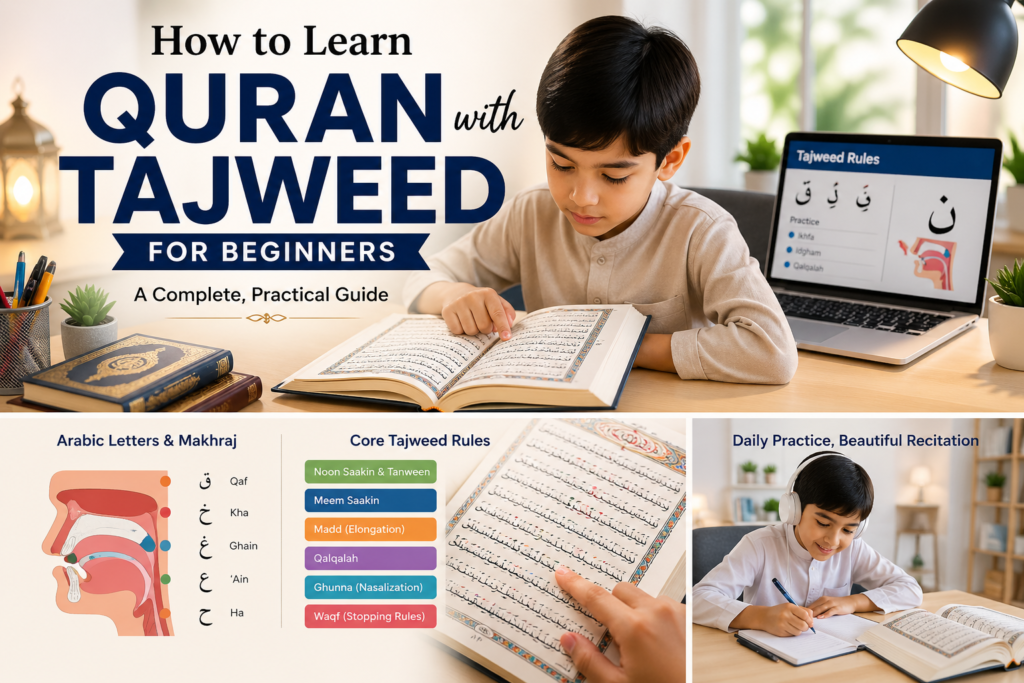
If you have ever listened to a beautiful Quran recitation and thought, I want to read like that, you are not alone. There is something about a voice that recites the Quran correctly, each letter landing in exactly the right place, each word flowing into the next, that reaches the heart in a way that is hard to explain.
That quality of recitation has a name. It is called Tajweed. And the good news is that it is not reserved for scholars or professional reciters. Any beginner can learn it. It takes patience, the right guidance, and consistency. But it is completely within reach.
This guide will walk you through everything you need to know to start your journey and learn Quran with Tajweed from the very beginning.
What Is Tajweed and Why Does It Matter?
The word Tajweed comes from the Arabic root meaning to improve or to do something well. In the context of Quran recitation, it refers to the set of rules that govern how every letter and word should be pronounced correctly.
The Quran was revealed in Arabic, and Arabic is a language where pronunciation carries real weight. A single letter mispronounced can change the meaning of a word entirely. This is why the Prophet Muhammad, peace be upon him, and his companions recited the Quran with extreme care. The rules of Tajweed preserve that accuracy across generations.
Learning Quran Tajweed for beginners is not just about sounding beautiful, though that is a natural result. It is about reading the words of Allah the way they are meant to be read, with the correct sounds, the correct pauses, and the correct flow.
| IMPORTANT TO KNOW Scholars agree that applying Tajweed when reciting the Quran is an obligation. Reading without it is not a sin if you are still learning, but working towards correct recitation is part of every Muslim’s responsibility to the Book of Allah. |
Can a Complete Beginner Really Learn Tajweed?
Yes. Absolutely. The idea that Tajweed is only for advanced students is one of the most common misconceptions that holds people back from starting. In reality, the earlier you begin learning Tajweed rules, the better. Starting correctly means you do not have to unlearn bad habits later.
Children who grow up learning Tajweed from the beginning absorb the rules naturally, almost like a second language. Adults who start later can learn just as well. It simply takes a little more conscious effort at first. Either way, the path is the same: start with the basics, work with a qualified teacher, and practise a little every day.
Step by Step: How to Start Learning Tajweed
Follow these six steps in order. Skipping ahead creates gaps that slow you down later. Each step builds directly on the one before it.
Your 6-Step Tajweed Learning Roadmap
| # | Step | What to Do |
|---|---|---|
| 1 | Learn the Arabic alphabet correctly first | Before Tajweed rules, you need to know your Arabic letters and their basic sounds. Every letter has a specific point of articulation called Makhraj. |
| 2 | Work through Noorani Qaida | This is the standard beginner book used across the world. It teaches letter recognition, joining letters, and basic pronunciation in a structured way. |
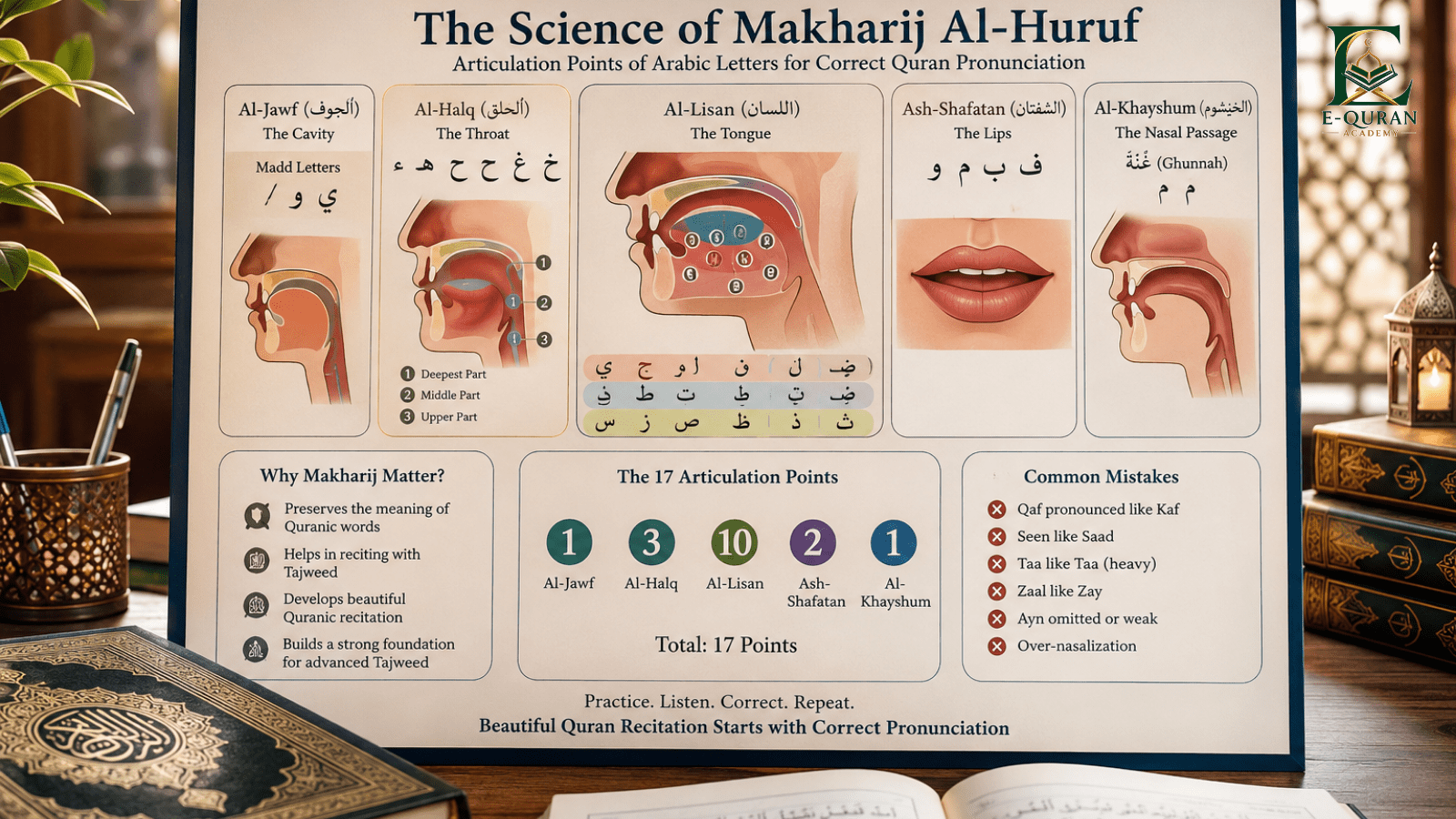
| 3 | Understand the concept of Makhraj | Makhraj refers to the exact place in your mouth or throat where a letter is produced. Arabic has 17 articulation points. A teacher will guide you through each one practically. |
| 4 | Learn the core Tajweed rules one at a time | Do not try to learn everything at once. Begin with Noon Saakin and Tanween, then Meem Saakin, then Madd. Build knowledge layer by layer. |
| 5 | Apply rules while reading actual Quran | Rules learned in isolation are not enough. Real learning happens when you apply them in Quranic text. Your teacher will correct you in real time. |
| 6 | Listen to a skilled reciter every day | Your ear needs training as much as your tongue. Listening to reciters like Sheikh Sudais helps you internalise the sound of correct Tajweed. |
The Core Tajweed Rules Every Beginner Should Know
There are many rules in Tajweed, but as a beginner you do not need to master all of them before you start reading. Here are the six foundational rules that come up constantly in Quranic text and that every beginner should understand first.
6 Essential Tajweed Rules for Beginners
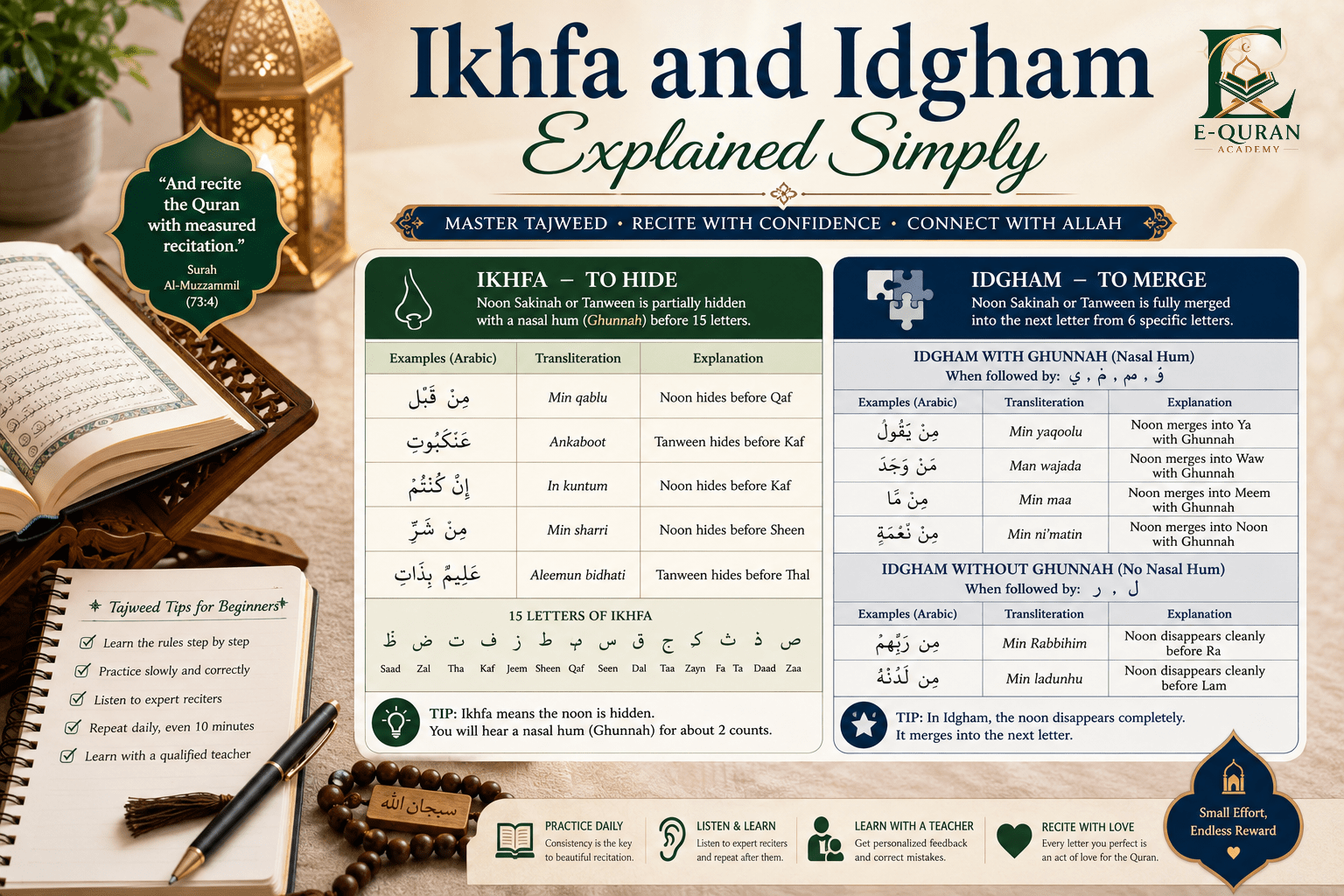
| Rule 01 Noon Saakin and Tanween Governs how the noon sound changes depending on the letter that follows it. Includes Idgham, Ikhfa, Iqlab, and Izhar. | Rule 02 Meem Saakin Rules for how a silent meem interacts with the next letter. Includes Ikhfa Shafawi and Idgham Shafawi. |
| Rule 03 Madd (Elongation) Rules for how long certain vowel sounds should be stretched. Different types of Madd require different counts. | Rule 04 Qalqalah A slight echo sound applied to five specific letters when they carry a sukoon. Very common in the short surahs beginners learn first. |
| Rule 05 Ghunna (Nasalisation) A nasal sound held for two counts, applied to noon and meem in certain positions. One of the most frequent rules in the Quran. | Rule 06 Waqf (Stopping Rules) Rules that tell you where it is correct to stop, where you must continue, and where you have a choice during recitation. |
Why You Need a Teacher, Not Just an App
This point cannot be overstated. Tajweed is an oral tradition. It was passed from the Prophet, peace be upon him, to his companions by voice, and it has been transmitted that way across fourteen centuries. You cannot fully learn it from a book or an app alone.
The reason is simple. Tajweed involves sounds that do not exist in most languages. The heavy letters, the throat sounds, the nasal elongations. You can read the description of how to produce these sounds a hundred times and still get them wrong. A teacher hears your mistake immediately and corrects it. That is something no app can do.
This is why online Quran classes with Tajweed have become so valuable. You get the benefit of a qualified human teacher, real time correction, and personalised feedback, all from home. Platforms like E Quran Academy offer one on one sessions with certified teachers who specialise in Tajweed instruction for beginners. You do not need to find a local institute or adjust to a fixed schedule. You can learn at a time that works for you, with a teacher whose only focus during that session is your recitation.
How to Practise Tajweed at Home Between Lessons
Your lessons with a teacher are where you learn and get corrected. But the real progress happens in the time between lessons, when you practise on your own. Here is how to make that practice genuinely effective.
Read aloud every single day
Silent reading does not train your tongue. Tajweed is a physical skill, like playing an instrument or learning a sport. You have to produce the sounds out loud, even when no one is listening. Even ten minutes of focused reading every day adds up significantly over weeks and months.
Record yourself and listen back
This is one of the most powerful tools available to any Tajweed learner. Record a short passage on your phone, then listen back. You will hear mistakes that you cannot catch in real time when you are focused on reading. Compare your recording to a qualified reciter reading the same passage.
Focus on one rule at a time
When you are reading, try not to think about every rule simultaneously. Pick one rule you are currently working on and pay close attention to it throughout your session. This focused approach builds mastery faster than trying to apply everything at once.
Use a colour coded Tajweed Quran
A Tajweed Quran uses different colours to indicate where different rules apply. The colour coding helps you visually identify rules in the text while reading, which reinforces the connection between the written rule and its application in real Quranic verses.
| BEGINNER TIP Start with the surahs you already know from your daily prayers. You hear them five times a day which means your ear already has a sense of how they should sound. Applying Tajweed to familiar text is easier and more satisfying than starting with unfamiliar passages. |
How Long Does It Take to Learn Tajweed?
This is one of the first questions every beginner asks, and the honest answer is that it depends on several things: how often you practise, the quality of your teacher, and your starting point with Arabic.
A learner who has no Arabic background and takes two lessons a week with daily personal practice can typically read basic surahs with correct Tajweed within six to twelve months. Fluent, confident recitation of longer portions of the Quran takes longer, often two to three years of consistent work.
But here is what matters more than the timeline. The journey itself carries reward. Every time you sit down to improve your recitation, that effort is recorded. The Prophet, peace be upon him, said that the one who recites the Quran with difficulty while striving to do so correctly will receive double the reward. You are not penalised for being a beginner. You are rewarded for trying.
Choosing the Right Online Tajweed Classes
Not all online Tajweed classes are equal in quality. When choosing a platform or teacher, certain things genuinely matter. This comparison will help you know what to look for and what to avoid.
What to Look For When Choosing an Online Quran Academy
| What to Look For | Good Sign | Warning Sign |
|---|---|---|
| Ijazah-certified teachers | Only qualified reciters with verified certification teach you | Self-taught instructors with no formal verification |
| Structured curriculum | Clear beginner to advanced progression with assessments | Random lessons with no clear roadmap |
| Free trial class | Try before you commit. Good academies welcome this | Payment required before any trial or testing |
| One on one sessions | Personal attention, instant correction, your pace | Group classes where individual mistakes go uncorrected |
| Flexible scheduling | Morning, evening, weekend options that fit your life | Fixed timetable that does not adjust to your routine |
At E Quran Academy, you can book a free trial session to meet your teacher and experience the lesson format before making any decision. The teachers are Ijazah certified, the curriculum is structured from beginner to advanced, and sessions are fully one on one so your learning is never shared with a group.
The Bigger Picture
Learning Quran with Tajweed is one of the most meaningful things a Muslim can invest time in. It deepens your connection to every prayer you make, every surah you recite, and every moment you spend with the Book of Allah.
You do not need to be a scholar to begin. You do not need perfect Arabic or a musical ear or a special gift. You need a sincere intention, a qualified teacher, and the willingness to show up consistently and learn.
Start today. Start small. Start with one surah you already know and decide to recite it correctly. That one decision, made sincerely, is the beginning of something that will stay with you for the rest of your life.
| Ready to learn Quran with Tajweed from home? E Quran Academy offers one-on-one online Tajweed classes for beginners, with certified teachers, flexible timing, and a free trial class to get you started. |