Introduction
If you have ever sat down to recite the Quran and felt that your pronunciation just wasn’t right, you’re not alone. Millions of Muslims around the world share that same feeling a deep desire to recite Allah’s words beautifully, but uncertainty about where they’re going wrong.
The truth is, making tajweed mistakes as a beginner is completely normal. In fact, it’s a natural part of the learning journey. But knowing what those mistakes are, and why they happen, is what helps you actually move past them.
In this article, we’ve put together the seven most common tajweed mistakes beginners make, along with practical tips to help you fix them. Whether you’re just starting out or you’ve been reciting for a while but want to improve, this guide is for you.
Why Tajweed Matters in Quran Recitation
Tajweed isn’t just a set of technical rules. It’s about giving each letter of the Quran its rightful sound and proper place. When you recite with correct Tajweed, you’re honoring the words of Allah in the most careful and sincere way possible.
And recite the Quran with measured recitation.
Surah Al-Muzzammil (73:4)
This verse is a direct instruction from Allah to recite the Quran slowly, clearly, and with proper Tajweed. It’s not a suggestion. It’s a command that reflects how much care the Quran deserves.
The Prophet Muhammad ﷺ also said: “The one who recites the Quran proficiently will be with the noble, righteous angels.” (Sahih al-Bukhari, Hadith 4937). This beautiful hadith is a reminder that every effort you make to improve your recitation carries great reward.
Mistake 1: Rushing Through Quran Recitation
One of the first and most common mistakes beginners make is reading too fast. It’s tempting to race through a Surah, especially if you feel self-conscious or want to get it done. But speeding through the Quran causes letters to blur together, rules to be skipped, and words to lose their meaning entirely.
Think of it this way. If you tried to read a beautiful poem at full sprint, you’d miss everything that makes it special. The Quran is no different. Slowing down isn’t a sign of weakness; it’s a sign of respect. Start with shorter Surahs, take your time with each word, and let the rhythm come naturally.
Mistake 2: Incorrect Pronunciation of Arabic Letters
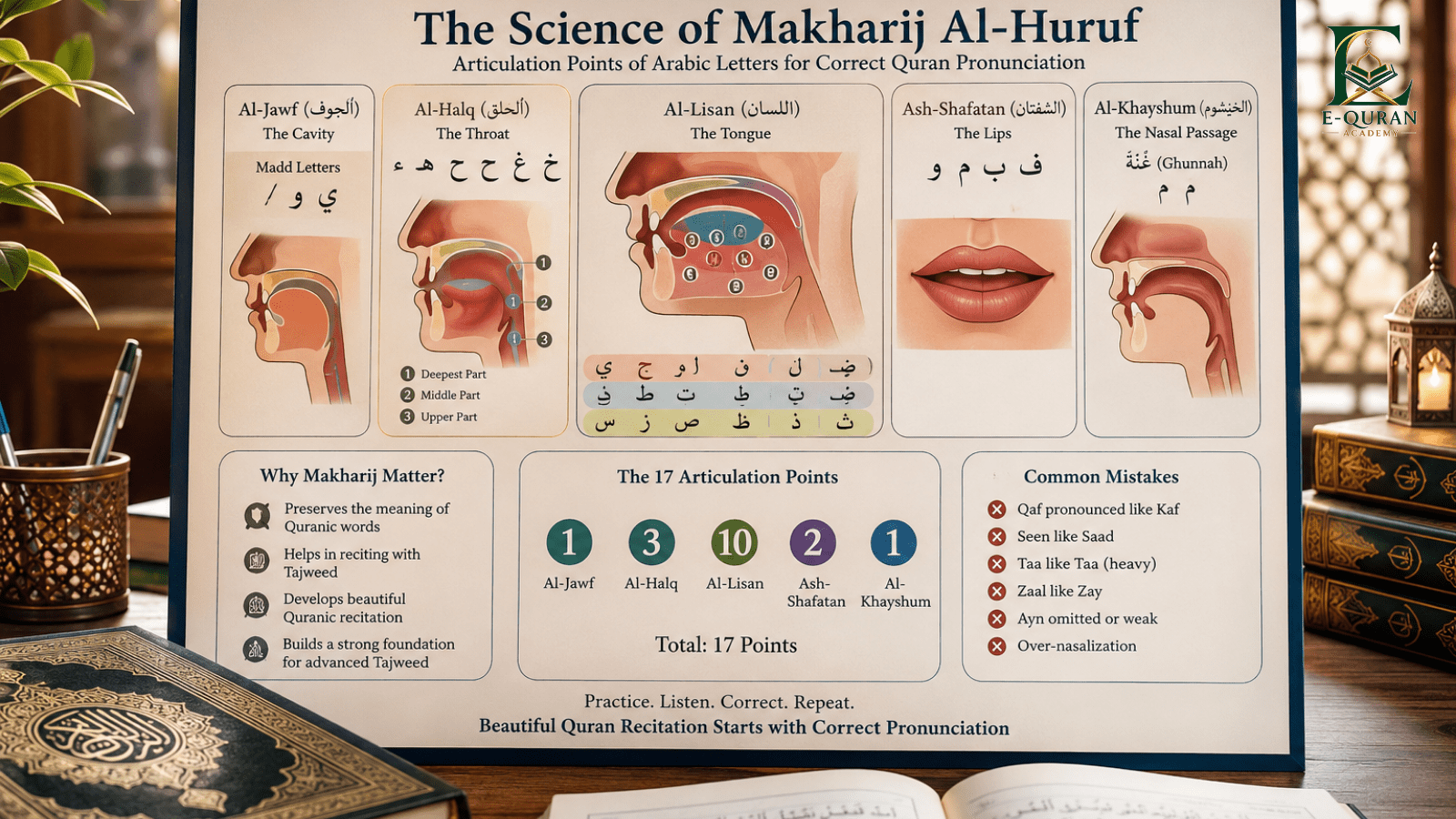
Arabic has letters that simply don’t exist in English. Letters like Ayn, Ghain, Ha, and Qaf require specific articulation points in the throat or mouth. Many beginners substitute these with sounds they’re already familiar with, which changes the meaning of words completely.
For example, confusing the heavy Ha with the light Ha might seem minor, but in Quranic Arabic, they are very different letters with different sounds and places of origin in the vocal tract. This is why learning from a qualified teacher, rather than just a book, makes such a big difference. A Best Teacher can hear your mistakes in real time and correct them before they become habits.
Mistake 3: Ignoring Madd Rules
Madd simply means prolongation. Stretching a vowel sound for a specific number of counts. Many beginners either skip the prolongation entirely or hold it for the wrong length of time. This is one of those mistakes that’s easy to make and easy to fix once you understand the basics.
There are different types of Madd in Tajweed, and each one has a specific number of counts. For example, Madd Tabee’i (natural prolongation) is always 2 counts, while Madd Lazim can go up to 6 counts. Getting this right gives your recitation a natural, melodic flow that feels deeply connected to the Quran’s beauty. Once you start noticing Madd, it’s actually quite satisfying to get it right.
Mistake 4: Not Practicing Daily
Tajweed is a skill, and like any skill, it improves with regular practice. Many beginners make the mistake of studying Tajweed only once or twice a week and then wondering why progress is so slow. Consistency matters far more than duration.
Even 10 to 15 minutes of daily recitation practice will get you further than a two-hour session once a week. The repetition builds muscle memory in your tongue and lips, making correct pronunciation feel more natural over time. Try reciting a few verses every morning after Fajr prayer. It becomes a peaceful habit that also connects you spiritually to your day.
Mistake 5: Learning Without Listening Carefully
Reading rules from a textbook is one thing. Hearing those rules applied in beautiful recitation is something else entirely. Many beginners focus only on the written rules without spending time actually listening to skilled reciters like Sheikh Mishary Rashid Alafasy or Sheikh Abdul Rahman Al-Sudais.
Listening trains your ear. When your ear knows what correct Tajweed sounds like, your mouth naturally starts to follow. Try listening to a verse recited slowly and clearly, then repeat it yourself. This technique, called “listen and repeat,” is one of the most effective ways to improve your Quran recitation quickly. It’s the same way children naturally pick up language, by hearing it repeatedly before speaking it.
Mistake 6: Reading Without Understanding Basic Rules
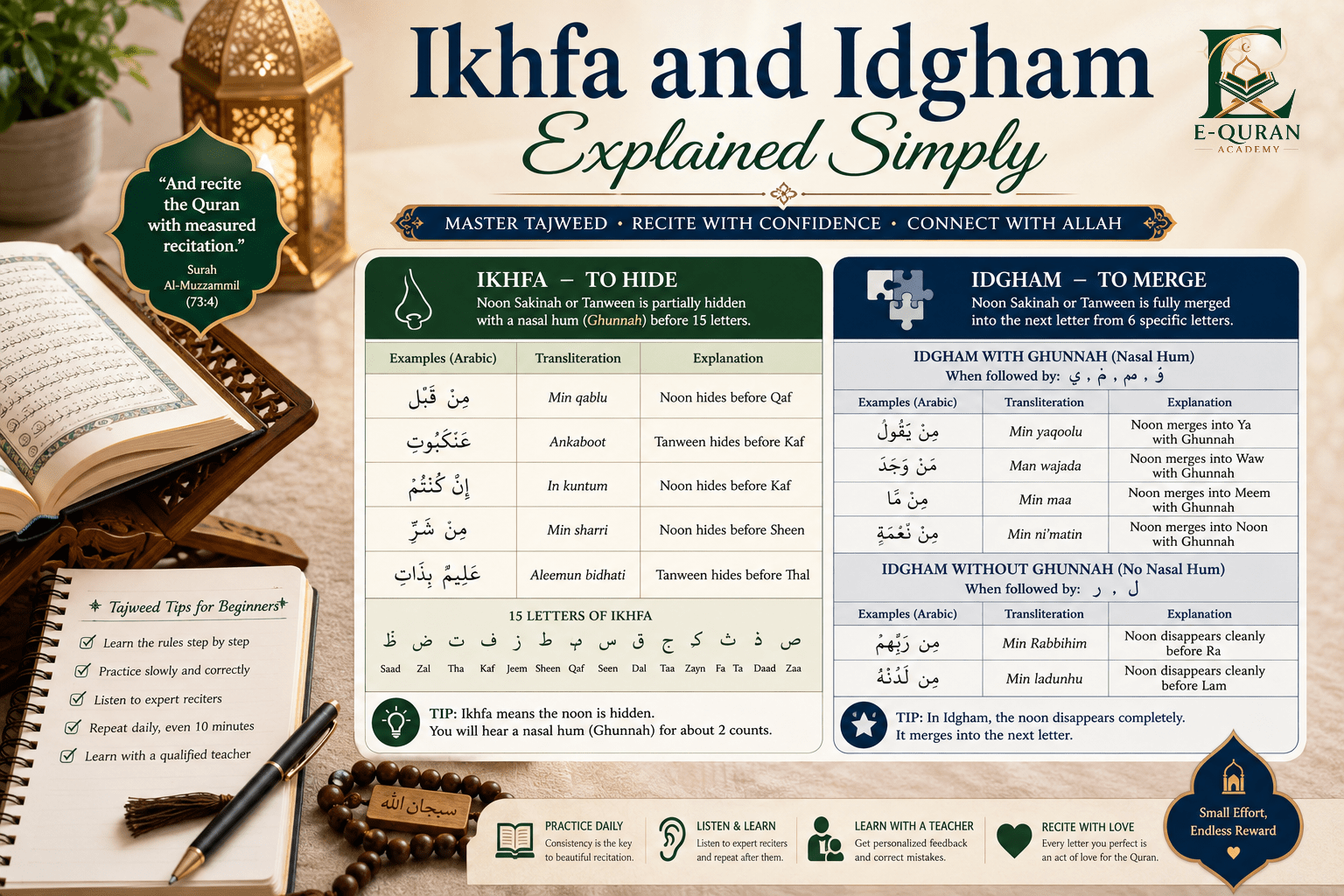
Some beginners jump straight into reading the Quran without ever learning the foundational Tajweed rules, things like Noon Sakinah, Tanween, Qalqalah, and the rules of Lam. Without this foundation, they end up applying rules incorrectly or skipping them altogether without even realizing it.
You don’t need to master every rule before you start reciting, but knowing the basics makes a massive difference. A structured course like a Noorani Qaida Course gives you a strong starting point, covering Arabic letters, vowels, and beginner Tajweed rules in a simple, step-by-step way. It sets up everything that comes after, making the more advanced rules much easier to understand.
Mistake 7: Feeling Embarrassed About Mistakes
This one might be the most overlooked mistake of all. Many beginners feel so embarrassed about mispronouncing letters or getting rules wrong that they avoid practicing altogether, or they refuse to recite in front of a teacher who could actually help them.
Here’s something important to remember: the Prophet ﷺ said that even the one who finds the Quran difficult to recite and struggles with it gets a double reward, one for reciting, and one for the effort. (Sahih al-Bukhari, Hadith 4937). That struggle you feel? Allah sees it and values it. There is no shame in being a beginner. Be patient with yourself. Keep going.
Easy Tips to Improve Tajweed Faster
Now that you know the common mistakes, here are some genuinely practical steps to help you improve:
- Start with the Noorani Qaida Course. If you’re a true beginner, this course builds your foundation properly, covering every Arabic letter, vowel, and basic rule in a clear, structured way.
- Enroll in a Quran Reading With Tajweed class. Having a live teacher correct your mistakes in real time is irreplaceable. Even online classes make a huge difference compared to learning alone.
- Listen daily to a reciter you love. Pick one Surah and listen to it every day this week. Notice the pauses, the prolongations, and the softness in certain letters.
- Record yourself reciting. It feels uncomfortable at first, but hearing your own voice is one of the fastest ways to catch mistakes you didn’t know you were making.
- Don’t skip Basic Islamic Studies. Understanding the meaning behind what you recite deepens your connection to it and naturally improves how you recite.
- Use Online Quran Classes consistently. Platforms like E Quran-Academy offer beginner-friendly Tajweed learning in a flexible, supportive environment, so you can learn at your own pace from home.
A gentle reminder: Improving your Tajweed is an act of worship. Every correct letter carries reward. Every effort, even an imperfect one, is seen by Allah. Progress matters more than perfection.
Conclusion
Making common tajweed mistakes is part of almost every beginner’s journey. The letters are unfamiliar, the rules feel overwhelming, and it takes time for your tongue to catch up with what your heart already wants to say. That’s okay. That’s normal. That’s part of learning.
What matters is that you keep going. You stay consistent. You find a good teacher. You listen more, practice more, and resist the urge to give up when it gets difficult. The Quran is worth every effort you give it.
Whether you’re starting from scratch or trying to refine what you already know, E Quran-Academy is here to support your journey, with structured courses, qualified teachers, and an environment built for learners just like you.
May Allah make the Quran easy on your tongue, fill your heart with its light, and reward you abundantly for every letter you recite. Ameen.
Frequently Asked Questions
The most common tajweed mistakes include rushing through recitation, mispronouncing Arabic letters, ignoring Madd (prolongation) rules, not practicing consistently, and learning without a qualified teacher. Knowing these mistakes early helps you avoid them and build better habits from the start.
The time varies from person to person, but most beginners start to notice real improvement within 3 to 6 months of consistent daily practice with a qualified teacher. The key is regularity. Even 15 minutes a day makes a significant difference over time.
Yes, absolutely. Online Tajweed classes have become a very effective and accessible option for beginners. With a good platform like E Quran-Academy, you get live one-on-one sessions with qualified teachers who can correct your mistakes in real time, just like an in-person class.
No, it is not sinful if you are genuinely trying to learn and improve. The Prophet ﷺ mentioned that the one who struggles with the Quran and finds it difficult receives a double reward. The sin is in intentionally ignoring Tajweed rules when you already know them. As long as you are learning sincerely, your effort is rewarded.