Introduction
There is something quietly powerful about listening to the Quran when it is recited beautifully. The rhythm feels balanced, the pronunciation is precise, and every word seems to carry meaning beyond just sound.
A lot of people feel that connection.
And almost as quickly, a thought follows:
“I wish I could read like that.”
But when you actually sit down to try, it doesn’t feel easy. The letters are unfamiliar. The sounds don’t come naturally. Even a simple line can feel difficult at first.
This is where many people stop.
Not because they don’t care, but because they don’t know where to begin.
That beginning is Noorani Qaida with Tajweed.
What is Noorani Qaida?
Noorani Qaida (نوراني قاعده) is a beginner’s learning method designed to teach how to read Arabic properly, specifically for Quran recitation.
It starts from the absolute basics:
- recognizing letters
- understanding their sounds
- learning how they connect
Instead of rushing into full verses, it builds your ability step by step.
It was developed by Molvi Noor Muhammad Haqqani, and over time it became one of the most widely used systems for teaching Quran reading across the world.
Think of it simply as the foundation before the Quran.
Why Starting with Noorani Qaida Matters
Many beginners try to start directly with the Quran.
At first, it feels like progress. You are reading words, moving forward, trying your best.
But slowly, small mistakes begin to form:
- confusing similar letters
- mispronouncing sounds
- skipping proper rules
These mistakes are not always obvious. And over time, they become habits.
In Quran recitation, pronunciation matters deeply. A small change in sound can change meaning.
Noorani Qaida prevents this problem from the beginning.
It slows the process just enough to make sure you build accuracy first, and confidence follows naturally.
Understanding Tajweed in Simple Words
Tajweed (تجويد) comes from an Arabic word meaning to improve or to make better.
In Quran recitation, it refers to giving each letter its proper right.
Every Arabic letter has:
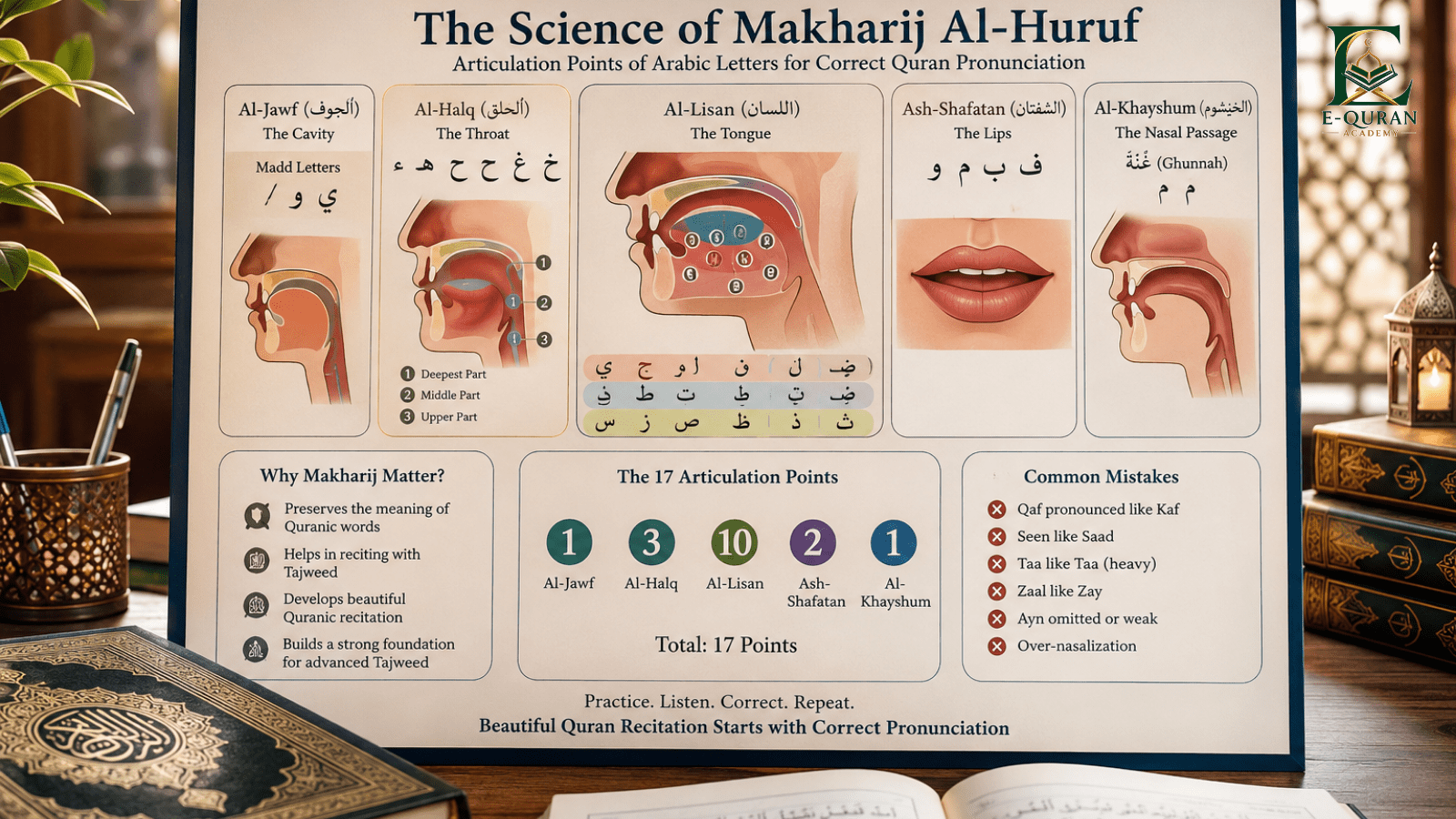
- a specific origin point (مخرج — makhraj)
- a specific characteristic (صفات — sifaat)
For example:
- the letter ع (‘Ayn) comes from the throat
- the letter ب (Ba) comes from the lips
Some letters are heavy (تفخيم), some are light (ترقيق), and some need to be stretched, which is called Madd (مد).
You do not need to memorize all these terms immediately.
Noorani Qaida introduces these concepts gradually, in a way that feels natural rather than overwhelming.
What You Learn Step by Step
As you move through Noorani Qaida, the learning follows a clear path.
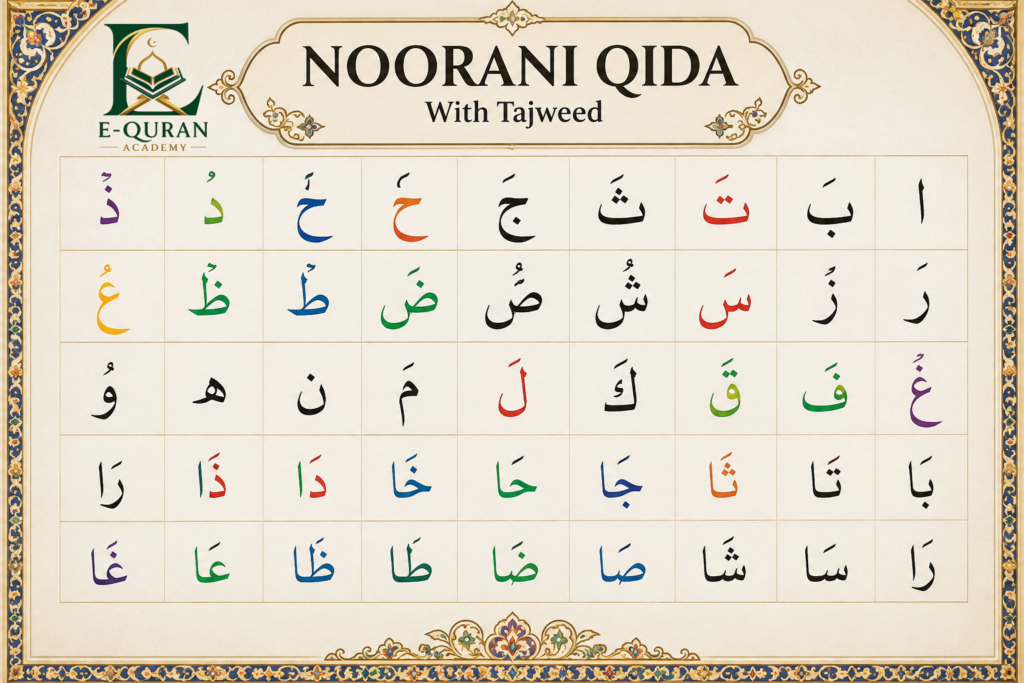
You begin with recognizing individual letters:
ا ب ت ث ج
Then you learn short vowels (حركات):
- Fatha (ـَ)
- Kasra (ـِ)
- Damma (ـُ)
After that, letters begin to join:
با ، تا ، جا
Then longer sounds are introduced through Madd letters:
ا ، و ، ي
You also learn:
- Sukoon (ْ) — when a letter has no vowel
- Shaddah (ّ) — when a letter is doubled
- Tanween (ً ٍ ٌ) — double vowel sounds
Gradually, these pieces come together into small words and then Quranic phrases.
That moment when you read your first full word correctly feels like real progress.
How Learning Actually Feels
At the beginning, it can feel slow.
Letters may look similar. Sounds may not come out correctly. You might repeat the same line several times.
That is completely normal.
Learning Quran reading is not about speed. It is about accuracy and consistency.
After a few days of regular practice, something changes.
Your tongue becomes more comfortable. Your ear starts recognizing correct sounds. Words begin to feel familiar.
What once felt difficult starts to feel manageable.
That shift is where real learning begins.
Common Mistakes to Avoid
Knowing these early can save a lot of time.
1. Rushing the Process
Trying to move fast often leads to weak pronunciation.
2. Ignoring Small Differences
Letters like س and ص or ح and ه may look similar but sound different.
3. Not Practicing Out Loud
Reading silently does not improve recitation. Your voice needs to be involved.
4. Skipping Tajweed Basics
Thinking you will fix it later usually makes correction harder.
5. Learning Without Guidance
It is difficult to notice your own mistakes without someone correcting you.
Practical Tips That Make Learning Easier
A simple routine works best.
- Practice daily, even if only for 10–15 minutes
- Repeat lessons until they feel comfortable
- Listen to skilled reciters regularly
- Read aloud, not silently
- Be patient with your progress
Also, take a moment before studying to make a short dua. It helps focus your intention and keeps the process meaningful.
A Real Learning Experience
Many learners feel discouraged at the start.
One student once shared that they believed they were “not good at Arabic.”
But after learning Noorani Qaida properly, their reading improved within weeks.
The difference was not ability.
It was the method.
Once the foundation became clear, everything else followed more easily.
Why Tajweed Changes the Experience
Reading with Tajweed is different from just reading words.
The sound becomes clearer. The rhythm becomes smoother. The recitation feels more connected.
Over time, it becomes something you look forward to.
Not just a task, but a moment of calm and focus.
Conclusion
Every meaningful journey starts with a simple step.
For Quran reading, that step is Noorani Qaida with Tajweed.
It gives you:
- a clear starting point
- a structured path
- and the confidence to continue
It does not matter how old you are or when you begin.
What matters is that you start correctly.
One letter at a time.
Final Thought
You do not need to master everything today.
Start small. Start Today, Get Free Trial Class
Open the Qaida. Read a few lines. Take your time.
Because once you begin, progress comes more naturally than you expect.
Frequently Asked Questions
What is the best age to start Noorani Qaida?
There is no fixed age. Children can start early, but adults can learn just as effectively with consistency.
How long does it take to complete?
Most learners complete it in 3 to 6 months, depending on practice.
Can I learn without a teacher?
You can begin on your own, but a teacher helps correct mistakes early and improves accuracy.
Is Noorani Qaida necessary?
It is not mandatory, but it provides a strong foundation for correct Quran reading.
Start your Quran learning journey today with expert teachers at E Quran Academy. Book your free trial class and begin learning Noorani Qaida with Tajweed step by step.