A complete guide for Muslim families in Australia | Dhul Hijjah 1447 AH
Every year, as the blessed days of Dhul Hijjah approach, Muslim families across Australia begin asking the same question with that familiar mix of excitement and spiritual anticipation: when exactly is Eid al Adha 2026 in Australia? There is something beautiful about that question. It carries within it the love of this Ummah for one of Islam’s greatest occasions.
For Muslims living in Australia, the answer is not always as simple as checking a regular calendar. The Islamic calendar is lunar, which means dates shift each year, and the moon sighting plays a central role in determining the exact day. That is what makes it special. It connects us to a tradition that goes back centuries, to the very roots of how Muslims have always observed their faith.
This article will give you the confirmed expected date of Eid ul Adha 2026 in Australia, explain the importance of moon sighting, take you through the deep Islamic significance of this occasion, guide you through the Sunnahs of the day, and share everything your family needs to know to make this Eid truly meaningful.
Eid al Adha 2026 Date in Australia | What You Need to Know.
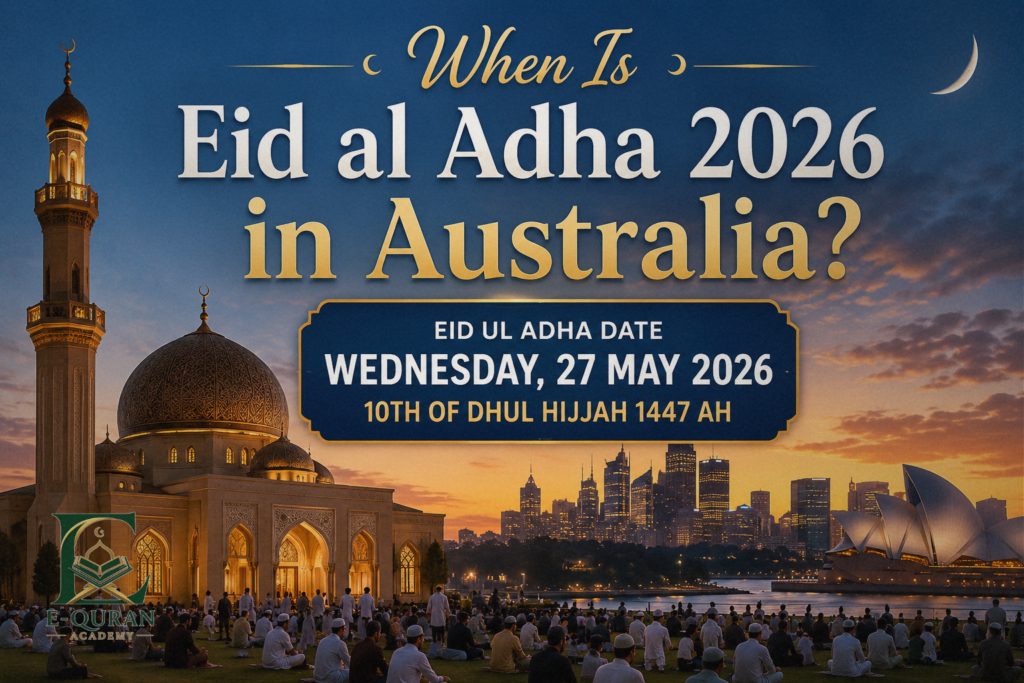
Based on the Islamic lunar calendar for 1447 AH, and confirmed by leading Australian Islamic authorities including Islamic Relief Australia and HalalHQ Australia, Eid al Adha 2026 in Australia is expected to fall on:
Wednesday, 27 May 2026
10th of Dhul Hijjah 1447 AH
The night of Eid begins at sunset on Tuesday, 26 May 2026. This is when the Takbeer starts and the spirit of Eid officially enters our homes.
The Day of Arafah, which falls on the 9th of Dhul Hijjah and is one of the most sacred days in the entire Islamic year, will be on Tuesday, 26 May 2026. This is the day it is highly recommended for non-pilgrims to fast.
It is always important to remember that the final confirmed date depends on the actual moon sighting for Dhul Hijjah. The crescent moon for Dhul Hijjah 1447 is expected to be sighted in mid-May 2026. Local Australian Islamic authorities such as the Australian National Imams Council (ANIC) and the Australian Federation of Islamic Councils (AFIC) will issue the official announcement. Always confirm with your local mosque, especially if you are booking Qurbani or making travel arrangements.
Moon Sighting Australia and Why It Is a Sacred Practice in Islam
Moon sighting is not simply a tradition or a historical custom. It is a living act of worship. In Islam, the beginning of every new month of the Hijri calendar is determined by the sighting of the new crescent moon, and this includes the sacred month of Dhul Hijjah.
The Prophet Muhammad, peace be upon him, gave this guidance clearly and directly:
Fast when you see the crescent moon, and stop fasting when you see it, and if it is hidden from you, complete thirty days of Sha’ban.
Sahih al-Bukhari, Hadith 1909 | Sahih Muslim, Hadith 1081
While this particular Hadith is about Ramadan, Islamic scholars unanimously apply the same moon sighting principle to Dhul Hijjah. Once the crescent moon of Dhul Hijjah is sighted and the first day is confirmed, Muslims count to the 10th day, which is when Eid al Adha is celebrated.
In Australia, the moon sighting situation has its own unique character. Australia’s geographic position in the Southern Hemisphere means that crescent visibility can differ from countries in the Middle East or Asia. This is why Australian Islamic bodies conduct their own observations and release their own official announcements.
For Muslim families across Sydney, Melbourne, Brisbane, Perth, and Adelaide, the most reliable approach is to follow the official announcement from your mosque or from ANIC. This is not just a practical choice. It is a way of maintaining community unity, which Islam strongly encourages.
The Islamic Importance of Eid ul Adha A Festival Rooted in Sacrifice and Submission.
To truly feel Eid ul Adha in your heart, you need to know the story behind it. And what a story it is.
Allah Almighty tested His beloved Prophet Ibrahim, peace be upon him, with one of the greatest trials a father could ever face. In a dream, Ibrahim saw himself slaughtering his own son, Ismail, peace be upon him. For a Prophet, a dream is a form of divine revelation. It was not just a dream. It was the command of Allah.
What happened next is one of the most moving moments in all of the Quran. Ibrahim, peace be upon him, told his son what he had seen. And Ismail’s response showed a maturity of faith that moves the heart every time you read it:
He said, ‘O my father, do as you are commanded. You will find me, if Allah wills, among the steadfast.’
Surah As-Saffat (37:102)
Father and son, both in complete submission to Allah, walked toward the place of sacrifice. As Ibrahim prepared to fulfill the command of his Lord, Allah called out to him in an extraordinary moment of mercy and honor:
We called out to him, ‘O Ibrahim, you have fulfilled the vision.’ Indeed, We thus reward the doers of good. Indeed, this was the clear trial. And We ransomed him with a great sacrifice.
Surah As-Saffat (37:104-107)
Allah replaced Ismail with a ram and spared the child. This was not just mercy. It was a proclamation to the entire world that true faith, true tawakkul, and true submission to Allah will always be honored.
This is the story that Eid ul Adha commemorates. Every year, through Qurbani, through prayer, through gratitude, Muslims all over the world renew that promise: we place our trust in Allah above everything else. Above comfort, above wealth, above what we love most in this dunya.
Eid ul Adha also coincides with the completion of Hajj, the pilgrimage that is one of the five pillars of Islam. While millions of pilgrims stand on the plain of Arafah on the 9th of Dhul Hijjah in one of the most powerful acts of collective worship this world has ever seen, the rest of the Muslim ummah joins in spirit, fasting, remembering, and celebrating together.
The Prophet, peace be upon him, confirmed the greatness of the Day of Sacrifice in these words:
The Day of ‘Arafah, the Day of Sacrifice, and the days of Al-Tashriq are our festival, us Muslims, and they are days of eating and drinking.
Jami’ al-Tirmidhi, Hadith 773 | Classed as Sahih by al-Albani
What Muslims Should Do on Eid ul Adha
Eid ul Adha is packed with acts of worship, gratitude, and community. Here is a warm and practical guide for Muslim families in Australia on how to spend this blessed day.
Fast on the Day of Arafah (26 May 2026)
Before Eid even arrives, there is an extraordinary opportunity for reward. The 9th of Dhul Hijjah, the Day of Arafah, falls on Tuesday, 26 May 2026. Fasting on this day carries one of the greatest rewards in the entire year.
Fasting on the Day of Arafah is an expiation for the preceding year and the following year.
Sahih Muslim, Hadith 1162
This fast is for those who are not performing Hajj. It is not obligatory but it is a powerful Sunnah that many Muslims around the world observe with deep gratitude. Do not miss this opportunity.
Offer the Eid Prayer
The Eid prayer on Wednesday, 27 May 2026 is one of the most important acts of the day. It is performed in congregation in the morning, usually between fifteen and forty-five minutes after sunrise.
The Prophet, peace be upon him, taught us clearly about the order of the day:
The first thing we do on this day of ours is to offer the prayer, then we return and slaughter the sacrifice. Whoever does so has followed our Sunnah.
Sahih al-Bukhari, Hadith 5545
The Eid prayer is also open to the entire family. Women, children, and even those who cannot pray are encouraged to attend, because the atmosphere of collective worship and Takbeer is itself a form of remembrance.
Sahih al-Bukhari, Hadith 971
In Australia, Eid prayers are held at mosques, community halls, and large outdoor venues across every major city. Check your local mosque for the exact time, location, and parking details, as announcements are usually made in the week before Eid.
Perform Qurbani After the Prayer
Qurbani, the ritual sacrifice of an animal on the 10th of Dhul Hijjah or the days following it, is an obligation for every Muslim who possesses wealth above the Nisab threshold. It is performed after the Eid prayer.
The meat of the Qurbani is divided into three equal portions: one for your own household, one for relatives and friends, and one for those in need. Allah mentions the purpose of this sacrifice beautifully in the Quran:
So mention the name of Allah over them when lined up, and when they have fallen on their sides, then eat from them and feed the needy and the one who does not ask. Thus have We subjected them to you that you may be grateful.
Surah Al-Hajj (22:36)
For Muslim families in Australia, Qurbani can be arranged through local halal butchers, licensed Australian abattoirs, or through trusted Islamic charities that perform the sacrifice on your behalf in countries where the meat is most urgently needed. Book early as slots fill up quickly in the weeks before Eid.
Say the Takbeer of Eid
From Fajr on the Day of Arafah (26 May) until Asr on the 13th of Dhul Hijjah, Muslims are encouraged to recite the Takbeer of Eid as much as possible:
Allahu Akbar, Allahu Akbar, La ilaha illallah, Allahu Akbar, Allahu Akbar, wa lillahil hamd.
Say it in your home, on the way to the prayer, or say it in the car, in the kitchen, with your children. These are the days of remembering Allah aloud and filling the air with His glorification.
The Companions of the Prophet, may Allah be pleased with them all, used to go out to the marketplace in these ten days and say Takbeer, and the people around them would say Takbeer when they heard it.
Sahih al-Bukhari, Tafseer of Surah Al-Hajj | Ibn Katheer
Give Generously to Those in Need
One of the defining features of Eid ul Adha is generosity. Share your Qurbani meat. Donate to an Islamic charity. Check on a neighbor who may be alone. Bring food to someone who is struggling. These acts of giving are not just cultural gestures. They are living expressions of the sacrifice and submission that this Eid is all about.
Spend Time with Family and Community
Eid is a community celebration. Visit relatives, share meals, greet your brothers and sisters with warmth and joy. The Prophet, peace be upon him, used to greet people on Eid by saying:
Taqabbalallahu minna wa minkum (May Allah accept from us and from you).
Al-Muhamiliyyat, reported from the Companions with authentic chains | Al-Albani authenticated this practice in Tamam al-Minnah
Teach this greeting to your children. Use it with every Muslim you meet on this day.
Make Sincere Dua
Do not let Eid pass without making sincere and heartfelt dua. These are the days when Allah frees people from the Fire in great numbers, when His mercy is especially close, and when the dua of a believer is readily accepted. Ask for forgiveness, for health, for guidance, for the Muslim Ummah around the world. Ask with full presence of heart.
Sunnahs of Eid ul Adha: Follow the Way of the Prophet
These are the established Sunnahs of Eid ul Adha that have come to us through authentic narrations. Practicing them turns every moment of the day into an act of worship.
- Take a complete ghusl (ritual bath) before going to the Eid prayer. This was the established practice of the Companions of the Prophet, peace be upon him, on the day of Eid.
- Wear your cleanest and best clothes. Dress up for Allah on this day. It is a Sunnah to adorn yourself as an expression of gratitude for His blessings.
- Apply a good scent or perfume if available. This is part of the overall preparation for the day.
- Do NOT eat anything before the Eid prayer on Eid ul Adha. This is different from Eid al-Fitr. On Eid al-Adha, the Sunnah is to delay eating until after the prayer and after the Qurbani. The Prophet, peace be upon him, would eat from his Qurbani meat as his first meal of the day.
Sahih al-Bukhari, Hadith 953
- Walk to the Eid prayer ground if it is reasonably close. The Prophet, peace be upon him, would walk to the prayer and return by a different route, greeting people along the way.
Sahih al-Bukhari, Hadith 986
- Recite the Takbeer loudly on the way to the prayer. This fills the streets with the remembrance of Allah and is one of the most beloved practices of this blessed day.
- Perform Qurbani immediately after the Eid prayer. The Prophet, peace be upon him, used to slaughter the sacrifice right at the prayer ground. Whoever performs Qurbani before the prayer, it does not count as Qurbani.
Hadith 5545 | Sahih al-Bukhari,
Dhikr and Adhkar for the Days of Dhul Hijjah
The first ten days of Dhul Hijjah, including the Day of Arafah and Eid itself, are described by the Prophet, peace be upon him, as the most virtuous days of the entire year. He said:
There are no days in which righteous deeds are more beloved to Allah than these ten days.
Sahih al-Bukhari, Hadith 969
Fill these days and especially the day of Eid with the following adhkar:
Takbeer
Allahu Akbar, Allahu Akbar, La ilaha illallah, Allahu Akbar, Allahu Akbar, wa lillahil hamd.
Allah is the Greatest, Allah is the Greatest, there is no god but Allah. Allah is the Greatest, Allah is the Greatest, and to Allah belongs all praise.
Recite this from Fajr on the Day of Arafah (26 May) until Asr on the 13th of Dhul Hijjah.
Tahleel
La ilaha illallah wahdahu la sharika lah, lahul mulku wa lahul hamdu wa huwa ‘ala kulli shay’in qadir.
There is no god but Allah alone, with no partner. To Him belongs all dominion and all praise, and He is over all things capable.
Tasbeeh, Tahmeed, Takbeer
The Prophet, peace be upon him, said: Let there be much Tahleel, Takbeer, and Tahmeed in these ten days.
Musnad Ahmad, Hadith 5446 | Authenticated by scholars including al-Albani
Subhanallah (Glory be to Allah).
Alhamdulillah (All praise belongs to Allah).
Allahu Akbar (Allah is the Greatest).
Eid Greeting Dua
Taqabbalallahu minna wa minkum.
May Allah accept from us and from you.
This was the Eid greeting of the Companions of the Prophet, peace be upon him, and it remains the most beautiful and authentic way to greet your fellow Muslims on this day.
Al-Muhamiliyyat | Authenticated by al-Albani
Dua Before Qurbani
Bismillah, Allahu Akbar. Allahumma hadha minka wa lak.
In the name of Allah, Allah is the Greatest. O Allah, this is from You and for You.
This is the dua recited at the time of performing the Qurbani.
Sunan Abi Dawud, Hadith 2795
Preparing Children for Eid Through Islamic Learning.
There is a very simple truth about Eid: a child who understands it celebrates it completely differently from a child who does not. When a child knows the story of Ibrahim and Ismail, when they can recite the Takbeer, when they understand why we sacrifice and why we give to the poor, then Eid becomes something that feeds their soul, not just their appetite.
This kind of understanding does not come from one conversation before Eid. It comes from consistent, loving, and structured Islamic education. For Muslim families in Australia, online learning has made this more accessible than ever before.
E Quran Academy offers a range of well-structured courses designed specifically for children and young learners in the English-speaking world. These include:
- Noorani Qaida Course, the perfect starting point for young children learning to recognize and pronounce Arabic letters correctly
- Quran Reading with Tajweed, helping children learn to recite the Quran the way it was revealed, with proper rules of pronunciation and elongation
- Quran Classes for Kids, structured and engaging lessons designed for young learners taught by qualified and patient teachers
- Basic Islamic Studies, covering the five pillars of Islam, the stories of the Prophets, the fundamentals of aqeedah, and practical Islamic manners
- Quran Memorization Course, for families whose children aspire to become Huffaz and carry the Book of Allah in their hearts
When a child can recite even a few verses of Surah As-Saffat and understand what they mean, Eid ul Adha transforms for them. It is no longer just a special day. It becomes a conversation with Allah, a reminder of His mercy, and a celebration of their own faith.
Online Islamic learning has been a real gift for Australian Muslim families. No matter where you live, whether in the heart of Melbourne or in a regional town hours from the nearest mosque, your child can receive qualified Islamic education consistently. That investment in your child’s faith is one of the most beautiful gifts you can give them.
Final Thoughts: Make This Eid Count
Eid al Adha 2026 in Australia falls on Wednesday, 27 May 2026, corresponding to the 10th of Dhul Hijjah 1447 AH. The night of Eid begins at sunset on Tuesday, 26 May. The Day of Arafah and the highly recommended fast will be on Tuesday, 26 May 2026.
Confirm the final date with your local mosque as moon sighting announcements from ANIC and AFIC will be released closer to mid-May 2026.
But more than any date, Eid ul Adha is a reminder. It is a reminder that this life is a test, that what Allah asks of us will always be for our own good, and that true success lies not in what we accumulate but in what we are willing to give up for His sake.
Ibrahim, peace be upon him, passed the greatest test with his complete trust in Allah. We may not face the same test, but every day we are asked to choose: do we put dunya first or do we put Allah first? Eid ul Adha reminds us of the answer.
So on Wednesday, 27 May 2026, wake up early. Take your ghusl. Dress beautifully. Say the Takbeer. Stand in prayer with your community. Perform your Qurbani. Feed someone who is hungry. Hug your family. Make sincere dua. And let the spirit of Ibrahim and Ismail, peace be upon them both, live in your heart.
May Allah accept our prayers, our Qurbani, our fasting, and our intentions. May He grant ease to every Muslim family in Australia and across the world. And may this Eid ul Adha 2026 be one that brings us all closer to Him.
Eid Mubarak. Taqabbalallahu minna wa minkum.