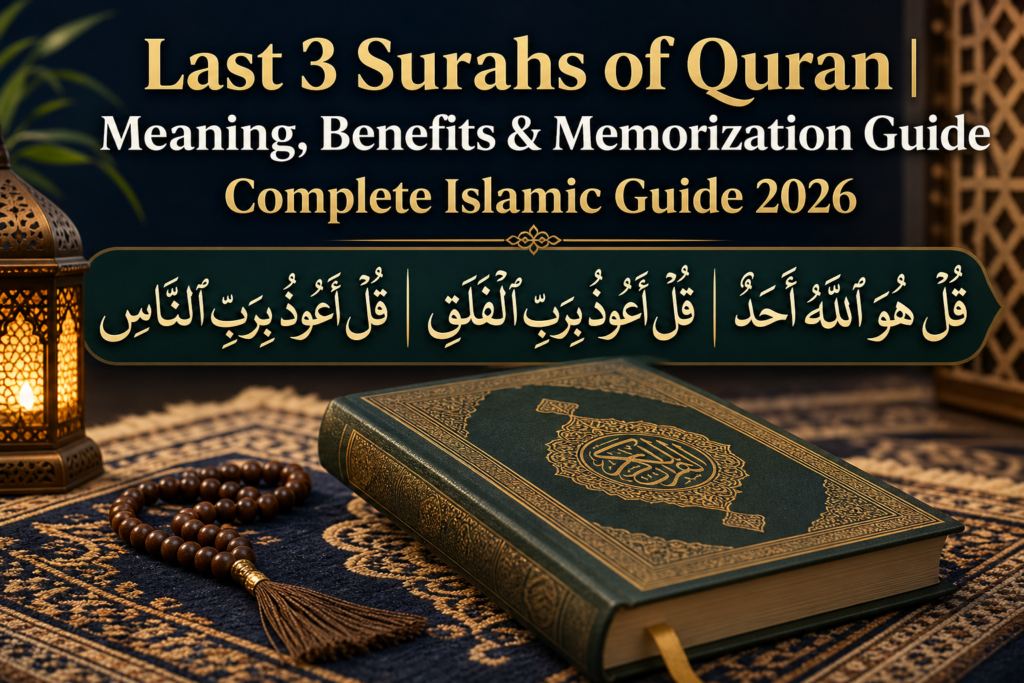
Complete Islamic Guide 2026
قُلْ هُوَ ٱللَّهُ أَحَدٌ | قُلْ أَعُوذُ بِرَبِّ ٱلْفَلَقِ | قُلْ أَعُوذُ بِرَبِّ ٱلنَّاسِ
Some parts of the Quran are so beautiful, so powerful, so perfectly complete that the Prophet ﷺ himself made them part of his daily routine. The last 3 surahs of the Quran are exactly that. Whether you are a beginner just starting your Quran journey or someone who has been Muslim their whole life, these three short surahs known as the 3 Qul Surahs carry a weight that goes far beyond their size.
Surah Ikhlas. Surah Falaq. Surah Nas. Three surahs. Fewer than twenty verses combined. And yet, their protection, their meaning, and their spiritual depth are extraordinary.
In this guide, you’ll find the Arabic text, simple translations, the real meaning behind each surah, the benefits of reciting them, the best times to read them and practical tips on how to memorize them easily. If you want to learn with a qualified teacher online, E Quran-Academy is a wonderful place to start but more on that later.
These three surahs are not just beautiful recitations. For Muslims, they are daily armour protecting the heart, the home, and the soul.
What Are the Last 3 Surahs of the Quran?
The Quran has 114 surahs (chapters). The last 3 surahs of the Quran are the final three chapters, placed right at the very end of the Holy Book. They are:
Surah Ikhlas — Surah 112
4 verses · “The Sincerity” · A complete declaration of Tawheed (Oneness of Allah)
Listen Surah Ikhlas in Beautiful Voice
Surah Falaq — Surah 113
5 verses · “The Daybreak” · Seeking refuge in Allah from all outer harm and evil
Listen Surah Falak in Beautiful Voice
Surah Nas — Surah 114
6 verses · “Mankind” · Seeking refuge in Allah from the whisperings of Shaytaan
Listen Surah An-Nas in Beautiful Voice
Together, Surah Falaq and Surah Nas are also called the Mu’awwidhatayn meaning “the two surahs of refuge.” And Surah Ikhlas, because it declares the pure Oneness of Allah, is considered equal in reward to one-third of the entire Quran. More on that shortly.
Last 3 Surahs of Quran Arabic Text & Translation
Here is the full Arabic text of each surah, with transliteration and simple English meaning. Reading the Arabic, even while learning, carries immense reward.
Surah Al-Ikhlas Surah 112 · 4 Verses
بِسْمِ ٱللَّهِ ٱلرَّحْمَـٰنِ ٱلرَّحِيمِ
قُلْ هُوَ ٱللَّهُ أَحَدٌ ﴿١﴾
ٱللَّهُ ٱلصَّمَدُ ﴿٢﴾
لَمْ يَلِدْ وَلَمْ يُولَدْ ﴿٣﴾
وَلَمْ يَكُن لَّهُۥ كُفُوًا أَحَدٌ ﴿٤﴾
Qul huwa Allahu ahad · Allahu s-samad · Lam yalid wa lam yulad · Wa lam yakun lahu kufuwan ahad
“Say: He is Allah, the One. Allah, the Eternal Refuge. He neither begets nor is born. Nor is there to Him any equivalent.”
Surah Al-Falaq Surah 113 · 5 Verses
بِسْمِ ٱللَّهِ ٱلرَّحْمَـٰنِ ٱلرَّحِيمِ
قُلْ أَعُوذُ بِرَبِّ ٱلْفَلَقِ ﴿١﴾
مِن شَرِّ مَا خَلَقَ ﴿٢﴾
وَمِن شَرِّ غَاسِقٍ إِذَا وَقَبَ ﴿٣﴾
وَمِن شَرِّ ٱلنَّفَّـٰثَـٰتِ فِى ٱلْعُقَدِ ﴿٤﴾
وَمِن شَرِّ حَاسِدٍ إِذَا حَسَدَ ﴿٥﴾
Qul a’udhu bi rabbi l-falaq · Min sharri ma khalaq · Wa min sharri ghasiqin idha waqab · Wa min sharrin naffathati fil ‘uqad · Wa min sharri hasidin idha hasad
“Say: I seek refuge in the Lord of daybreak from the evil of what He has created, and from the evil of darkness when it settles, and from the evil of those who blow on knots, and from the evil of an envier when he envies.”
Surah An-Nas Surah 114 · 6 Verses
بِسْمِ ٱللَّهِ ٱلرَّحْمَـٰنِ ٱلرَّحِيمِ
قُلْ أَعُوذُ بِرَبِّ ٱلنَّاسِ ﴿١﴾
مَلِكِ ٱلنَّاسِ ﴿٢﴾
إِلَـٰهِ ٱلنَّاسِ ﴿٣﴾
مِن شَرِّ ٱلْوَسْوَاسِ ٱلْخَنَّاسِ ﴿٤﴾
ٱلَّذِى يُوَسْوِسُ فِى صُدُورِ ٱلنَّاسِ ﴿٥﴾
مِنَ ٱلْجِنَّةِ وَٱلنَّاسِ ﴿٦﴾
Qul a’udhu bi rabbi n-nas · Maliki n-nas · Ilahi n-nas · Min sharri l-waswasi l-khannas · Alladhi yuwaswisu fi suduri n-nas · Mina l-jinnati wan-nas
“Say: I seek refuge in the Lord of mankind the King of mankind, the God of mankind from the evil of the whisperer who withdraws, who whispers into the hearts of mankind, from among the jinn and mankind.”
Surah Ikhlas, Falaq & Nas What Do They Really Mean?
Surah Ikhlas Pure Devotion to Allah’s Oneness
The word “Ikhlas” means sincerity and purity. This surah is essentially the most beautiful, most compact description of who Allah is. He is One. He is eternal As-Samad, the one upon whom all depend but who depends on nothing. He was not born. He did not give birth. And there is absolutely nothing in existence that is like Him.
Scholars say this single surah captures the entire concept of Tawheed Islamic monotheism in just four short sentences. That’s why it’s so extraordinary.
Surah Falaq Protection from External Harm
Al-Falaq means “the daybreak” the splitting of the dark sky by light. This surah asks Allah for refuge from all created harm: the dangers of the night, evil whispers, black magic (sihr), and the harm of those who carry jealousy in their hearts.
It’s a reminder that some things in this world carry danger and the only true protection comes from the Creator Himself.
Surah Nas Protection from Inner Whispers
Surah Nas turns the gaze inward. While Falaq deals with external evil, Nas deals with what attacks the heart and mind. The “whisperer” Al-Waswas is Shaytaan, who slips in and out of the hearts of people, planting doubt, fear, and sin.
This surah is a recognition that we need constant protection not just from the world outside, but from the thoughts that arise from within.
Powerful Benefits of the Last 3 Surahs What the Hadith Tell Us
Aisha (RA) reported: “Every night when the Prophet ﷺ went to bed, he would cup his hands together, blow into them, and recite Surah Ikhlas, Surah Falaq, and Surah Nas then wipe over his entire body as much as he could.” Sahih al-Bukhari, 5017
Complete protection at night Reciting all three after Fajr and Maghrib brings full spiritual protection for the day and night.
Equal to 1/3 of the Quran The Prophet ﷺ said Surah Ikhlas alone equals one-third of the Quran in reward (Sahih al-Bukhari).
Shield against black magic & evil eye Surah Falaq and Nas are the strongest Quranic protection against sihr and hasad (evil eye).
Peace of mind and heart Regular recitation brings tranquility, reduces anxiety, and strengthens one’s connection with Allah.
Protection for your home Reciting before sleep and after prayers creates a shield of remembrance around you and your family.
Immense reward in just minutes All three surahs take under two minutes to recite yet the rewards are described as immense and ongoing.
When to Recite the Last 3 Surahs Sunnah Times & Occasions
The Prophet ﷺ made these surahs part of his daily routine at specific times. Following his sunnah means you’re automatically building protection into your day without any extra effort.
After Fajr Prayer
Recite all three surahs 3 times each this provides complete protection for the entire day
After Maghrib Prayer
Same as Fajr 3 times each for protection through the night ahead
Before Sleeping
Recite once each, blow into cupped hands, and wipe over the body following the Sunnah of the Prophet ﷺ
When Unwell or Anxious
Recite them as ruqyah spiritual healing when feeling sick, worried, or spiritually low
After Every Salah
Recite once each after the five daily prayers as a general dhikr and protection practice
Recommended Learning Platform
Learn These Surahs with Proper Tajweed E Quran-Academy
Reading the Arabic text is beautiful. But reciting it correctly with proper Tajweed is where it becomes something else entirely. The right pronunciation of each letter, the rhythm of each verse, the breath in the right place these things transform recitation from words on a page into something that moves the heart.
E Quran-Academy offers live, one-on-one Quran classes online for both kids and adults across the USA. Their certified, Ijazah-holding teachers will help you recite the last 3 surahs correctly, memorize them with confidence, and build a foundation for the rest of your Quran learning journey.
Classes are flexible morning, afternoon, or evening so they fit around your life, not the other way around. Whether you’re a complete beginner or want to refine your recitation, a free trial class is the easiest first step.
✓ Ijazah-Certified Teachers ✓ Tajweed for Beginners ✓ One-on-One Classes ✓ Kids & Adults
✓ All US Timezones ✓ Free Trial Class
How to Memorize the Last 3 Surahs Easy Tips for Beginners
The good news? These are among the shortest surahs in the entire Quran. Surah Ikhlas has 4 verses. Surah Falaq has 5. Surah Nas has 6. Most beginners memorize all three within a week or two with consistent practice. Here’s how to do it properly:
- Start with listening not reading Find a clear, beautiful recitation (Mishary Al-Afasy or Abdul Rahman Al-Sudais are excellent) and listen to each surah many times before attempting to read it yourself. Your ears need to learn it first.
- Memorize one verse at a time Don’t try to memorize the whole surah at once. Take one ayah, repeat it 7 10 times until it’s solid, then move to the next. Only link them together once each is memorized individually.
- Say it out loud always Silent reading does not build memorization the same way. Recite aloud, even in a whisper. The movement of your mouth, the sound in your ears all of it reinforces memory far better than reading quietly.
- Recite in your salah immediately The moment you think you have a surah memorized, use it in your prayer. This is the single best test and reinforcement. Using it in salah gives it context and emotional weight it sticks much better.
- Morning and night revision Recite all three before sleep and after Fajr, every single day. Within a week, they’ll feel automatic. Within two weeks, you won’t be able to forget them even if you tried.
- Get corrected by a teacher. Memorizing the words is one thing. Making sure you’re pronouncing them correctly is another. A qualified teacher even for just a few sessions will catch errors you didn’t know you were making and set you on the right path.
Frequently Asked Questions
Why are the last 3 surahs of the Quran called “3 Qul Surahs”?
Because each of the three surahs begins with the Arabic word “Qul” meaning “Say.” Surah Ikhlas starts with “Qul huwa Allahu ahad,” Surah Falaq with “Qul a’udhu bi rabbi l-falaq,” and Surah Nas with “Qul a’udhu bi rabbi n-nas.” The name “3 Qul” is a simple, commonly used way to refer to this group of three surahs together.
What are the main benefits of reciting the last 3 surahs daily?
The benefits are both spiritual and protective. Reciting them after Fajr and Maghrib (3 times each) provides complete protection for the day and night according to authentic hadith. Surah Ikhlas carries the reward of one-third of the Quran per recitation. Surah Falaq and Nas protect against the evil eye, black magic, jealousy, and the whisperings of Shaytaan. Daily recitation also brings peace of mind and strengthens iman.
How long does it take to memorize the last 3 surahs of the Quran?
For most beginners, memorizing all three surahs takes between 5 to 14 days with consistent daily practice. Surah Ikhlas is usually the easiest and can be memorized in a day or two. Surah Falaq and Nas take a little longer due to slightly more verses. The key is daily repetition especially using them in salah which cements them much faster than passive reading alone.
Is Surah Ikhlas really equal to one-third of the Quran?
Yes this is mentioned in an authentic hadith in Sahih al-Bukhari. The Prophet ﷺ confirmed that Surah Ikhlas equals one-third of the Quran in terms of reward and meaning. Scholars explain this because the Quran covers three main themes: stories, commands, and the attributes of Allah. Surah Ikhlas covers the third theme the pure description of Allah’s nature completely and perfectly in just four verses.
Can a complete beginner learn the last 3 surahs with proper Tajweed online?
Absolutely. The last 3 surahs are actually the ideal starting point for any beginner they are short, powerful, and frequently used in daily prayers. Platforms like E Quran-Academy offer one-on-one Tajweed classes specifically designed for beginners, with patient certified teachers who will guide your pronunciation from the very first letter. A free trial class is available with no commitment required.
Conclusion Small Surahs, Enormous Blessings
There is something deeply humbling about the last 3 surahs of the Quran. They are so short that a child can memorize them in days. And yet, they carry within them the complete declaration of Tawheed, protection from every form of visible and invisible harm, and a spiritual weight that scholars have described for centuries.
The Prophet ﷺ recited them every single night before sleep. He recited them every morning and evening. He recited them when he was unwell. That alone tells us everything we need to know about their importance.
If you haven’t already made the last 3 surahs part of your daily routine start today. Recite them tonight before you sleep. Tomorrow morning after Fajr. Let them become the rhythm of your days. You’ll feel the difference.
And if you want to recite them properly with the correct Tajweed, the right pronunciation, the way the Prophet ﷺ recited them consider starting your journey with a qualified teacher. Even a few sessions can transform how you connect with these words.
Begin Your Quran Journey with E Quran-Academy
Learn the last 3 surahs and so much more with certified, patient Quran teachers online. One-on-one classes for kids and adults, available across all US time zones. Your first trial class is completely free. Book Your Free Trial Class Today No commitment · Learn Quran with Tajweed online · Kids & Adults · All levels welcome